What goes in a safety manual in Canada
A Canadian health and safety manual is the written program that shows how your company finds hazards, controls them, trains and supervises workers, responds to emergencies, investigates incidents and keeps records. A complete manual covers management commitment, hazard assessment and control, safe work practices, inspections, emergency response, investigations, committees or representatives, and how you manage visitors and other employers on site, with the forms to prove each one is done. Our 120 manuals are written for your province and trade, cost $499 CAD once and download instantly.
Updated
The 12 sections of a complete program
Provinces word their requirements differently, but every Canadian health and safety program is built from the same core elements. Every manual we sell is organised into these 12 sections, so you can find anything an auditor, client or inspector asks for in seconds.
- 01Management commitment. The signed policy statement, responsibilities and accountability for every level.
- 02Worker orientation and competency. How workers are oriented, trained, assessed as competent and supervised.
- 03Hazard assessment. How hazards are identified, rated and recorded before and during work.
- 04Hazard control. Controls by priority, personal protective equipment and the programs that put them in place.
- 05Codes of practice. Formal written procedures for high-risk work where the trade or the law calls for them.
- 06Safe work practices. Step-by-step practices for the tasks, tools and equipment of the trade.
- 07Inspections and maintenance. Workplace, equipment and vehicle inspections and preventive maintenance.
- 08Emergency response. Emergency plans, first aid, drills and contacts.
- 09Investigations. Reporting and investigating incidents and near misses, and tracking corrective actions.
- 10Program administration. Records, statistics, document control and the annual program review.
- 11Committees and representatives. The joint health and safety committee or representative and how they work.
- 12Visitors, contractors and other parties. Managing the public, visitors, subcontractors and other employers on your sites.
Safe work practices for the work you actually do
The sections above are the framework. The safe work practices are where a manual earns its keep: step-by-step instructions for the tasks, tools and equipment your crew uses every day. A construction manual carries 39 of them, an electrical manual 62 to 68 and an HVAC manual 56.
That is why a generic office manual does not work for a contractor, and why every one of our manuals is built for one trade in one province.
Forms and records that prove the program is working
A manual on a shelf proves nothing. Clients, prequalification platforms and inspectors look for records: hazard assessments, inspections, orientations, meeting minutes, incident investigations and corrective actions.
Every manual comes with fillable PDF forms for those records. The Alberta Construction package, for example, includes 35 forms alongside its 294 pages.
What you get with every manual
- The written program in Microsoft Word, organised into 12 sections that follow the elements of a typical Canadian health and safety program.
- Safe work practices for your trade, already written (each one would be $9 on its own).
- Fillable PDF forms for the records the program calls for: hazard assessments, inspections, incident reports, meeting minutes and more.
- The Implementation Kit (8 tools), including a quick-start guide, a 30/60/90-day checklist, sign-off sheets and a 12-month safety calendar.
- 52 toolbox talks for your trade, one for every week of the year.
- A free brand-it step: add your company name and logo and download a personalised Word file.
The Implementation Kit: 8 tools included with every manual
Start with your province and trade
Pick your province and trade and see every section, safe work practice and form before you pay.
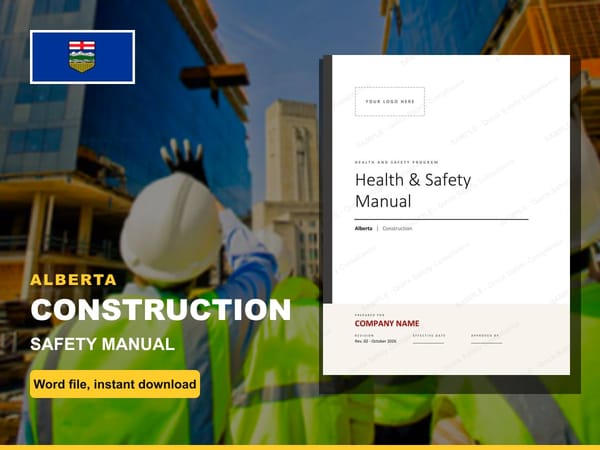
Alberta Construction Safety Manual
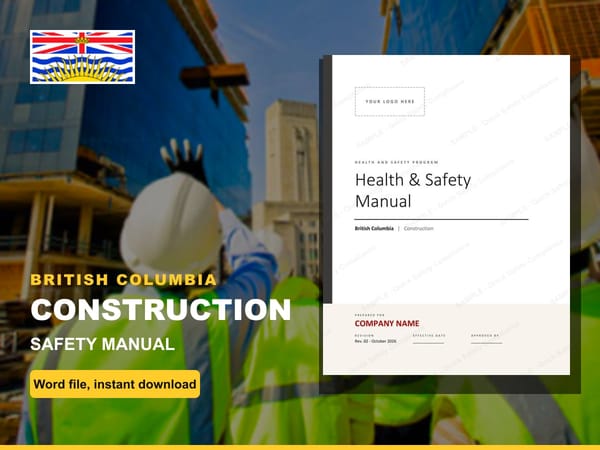
British Columbia Construction Safety Manual
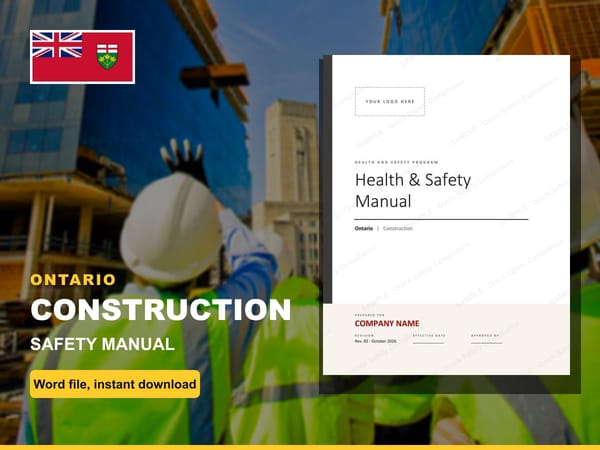
Ontario Construction Safety Manual
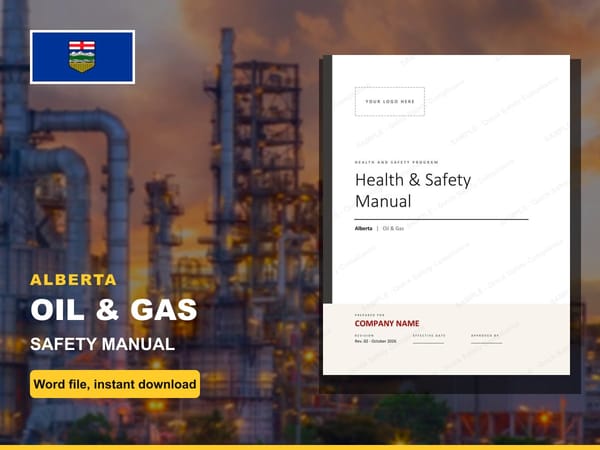
Alberta Oil and Gas Safety Manual
Questions
Is a safety manual required by law in Canada?
Every province requires employers to protect workers, assess hazards and keep certain records, and most require a written health and safety program once you reach a set number of workers. In Alberta, for example, an employer that regularly employs 20 or more workers must establish and implement a health and safety program. Clients and prequalification platforms usually ask for a written program long before the law does.
What format are the manuals in?
The manual is a Microsoft Word document you can edit, and the forms are fillable PDFs. Everything downloads instantly after payment.
How do I make the manual my own?
Three steps: add your logo, replace COMPANY NAME with your company name, and update the table of contents. The free brand-it step can do the first two for you and give you a personalised Word file. When Word asks to update the fields on opening, click Yes and the table of contents refreshes.
Will a safety manual get my company COR?
A manual gives you the written program a COR audit reviews. Certification comes from your certifying partner, after it audits your program in action.
Can I see what is inside before I buy?
Yes. Every manual page lists the sections, safe work practices and forms, with real page images from the file.
Get the document today
See every section before you pay, download it in minutes and make it yours with your company name and logo.