BC construction safety program requirements under WorkSafeBC
In British Columbia, an employer needs a formal occupational health and safety program if it has 20 or more workers and at least one workplace with a moderate or high hazard rating, or 50 or more workers (OHS Regulation, s. 3.1); smaller employers keep a less formal program built on monthly safety meetings with workers, with a record of each meeting (s. 3.2). On a construction site with workers of 2 or more employers, the prime contractor coordinates health and safety (Workers Compensation Act, s. 24), and many projects need a notice of project filed with WorkSafeBC at least 24 hours before work starts (s. 20.2). This post sets out those rules and construction requirements commonly checked on site.
By Quick Safety Compliance · · 6 min read
Formal program or less formal program
Section 3.1 of the OHS Regulation requires a formal program from an employer with a workforce of 20 or more workers and at least one workplace with a hazard rating of moderate or high (as defined in Schedule 3-A), and from any employer with 50 or more workers. Once it applies, it covers the whole of the employer's operations. An officer can also require a program in any workplace.
Below those numbers, section 3.2 requires a less formal program based on regular monthly meetings with workers to discuss health and safety, directed at correcting unsafe conditions and practices, with a record of each meeting and what was discussed. A small crew that holds and records a monthly safety meeting is meeting the minimum; a crew that bids on larger work will still be asked for the written program.
What a formal BC program must include
Section 3.3 lists the contents. A program written to these headings is easy for WorkSafeBC, a client or an auditor to follow:
- A statement of the employer's aims and the responsibilities of the employer, supervisors and workers.
- Regular inspection of premises, equipment, work methods and work practices at appropriate intervals, with prompt action on hazardous conditions found.
- Appropriate written instructions, available to all workers, to supplement the Regulation (your safe work practices and procedures).
- Periodic management meetings to review health and safety activities and incident trends.
- Prompt investigation of incidents to prevent them happening again.
- Records and statistics, including inspection and investigation reports, available to the joint committee or worker representative and, on request, to an officer.
- Instruction and supervision of workers in the safe performance of their work.
Inspections and new workers
Every employer must make regular inspections of all workplaces, including buildings, structures, grounds, excavations, tools, equipment, machinery and work methods, at intervals that prevent unsafe conditions from developing (s. 3.5). Put the interval in writing and keep the completed inspection forms.
Before a young or new worker begins work, the employer must give health and safety orientation and training specific to that workplace (s. 3.23(1)), and document it (s. 3.25). On a construction site a new worker can mean someone new to the company or new to the site, so a signed site orientation for every worker is the simplest way to show it was done.
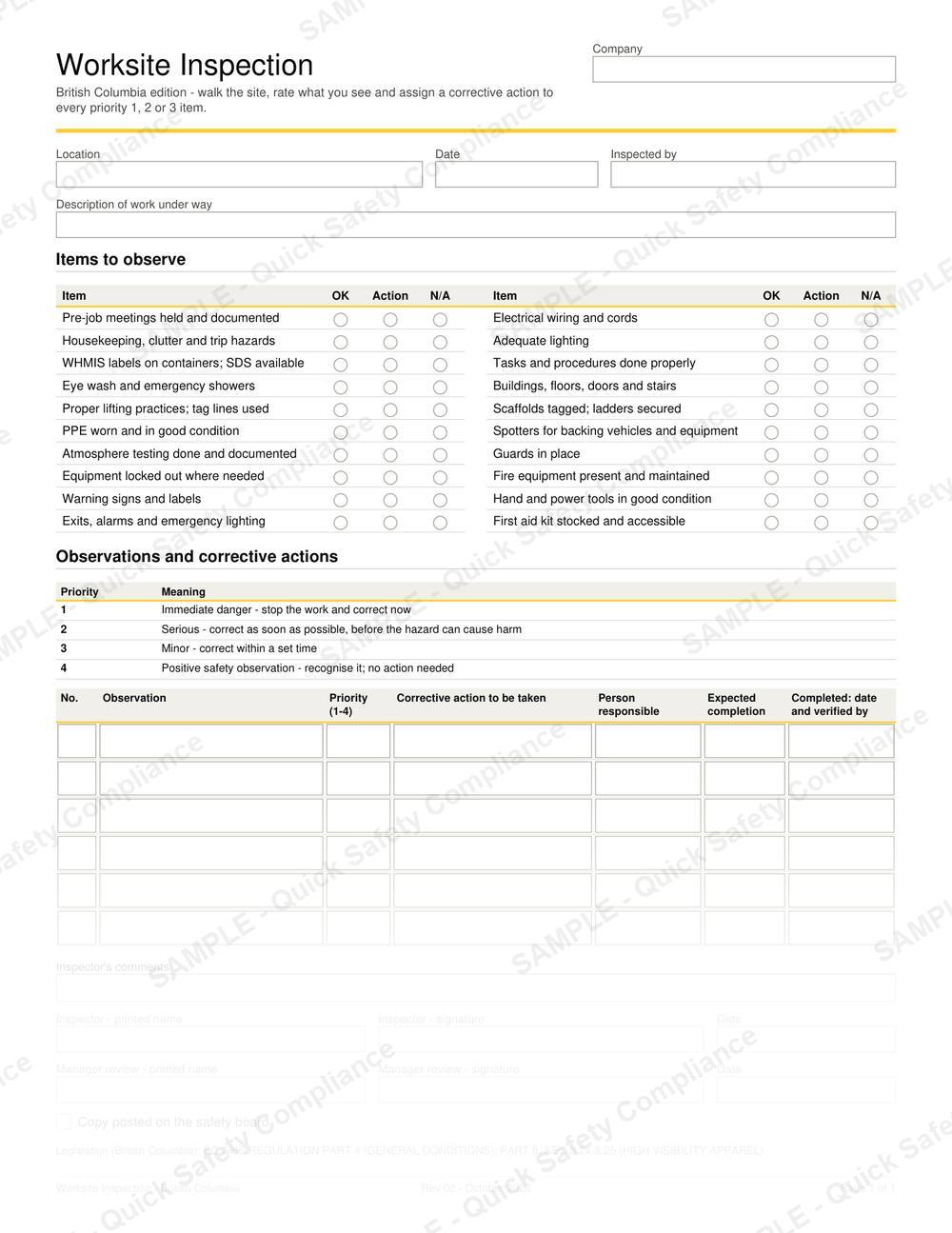
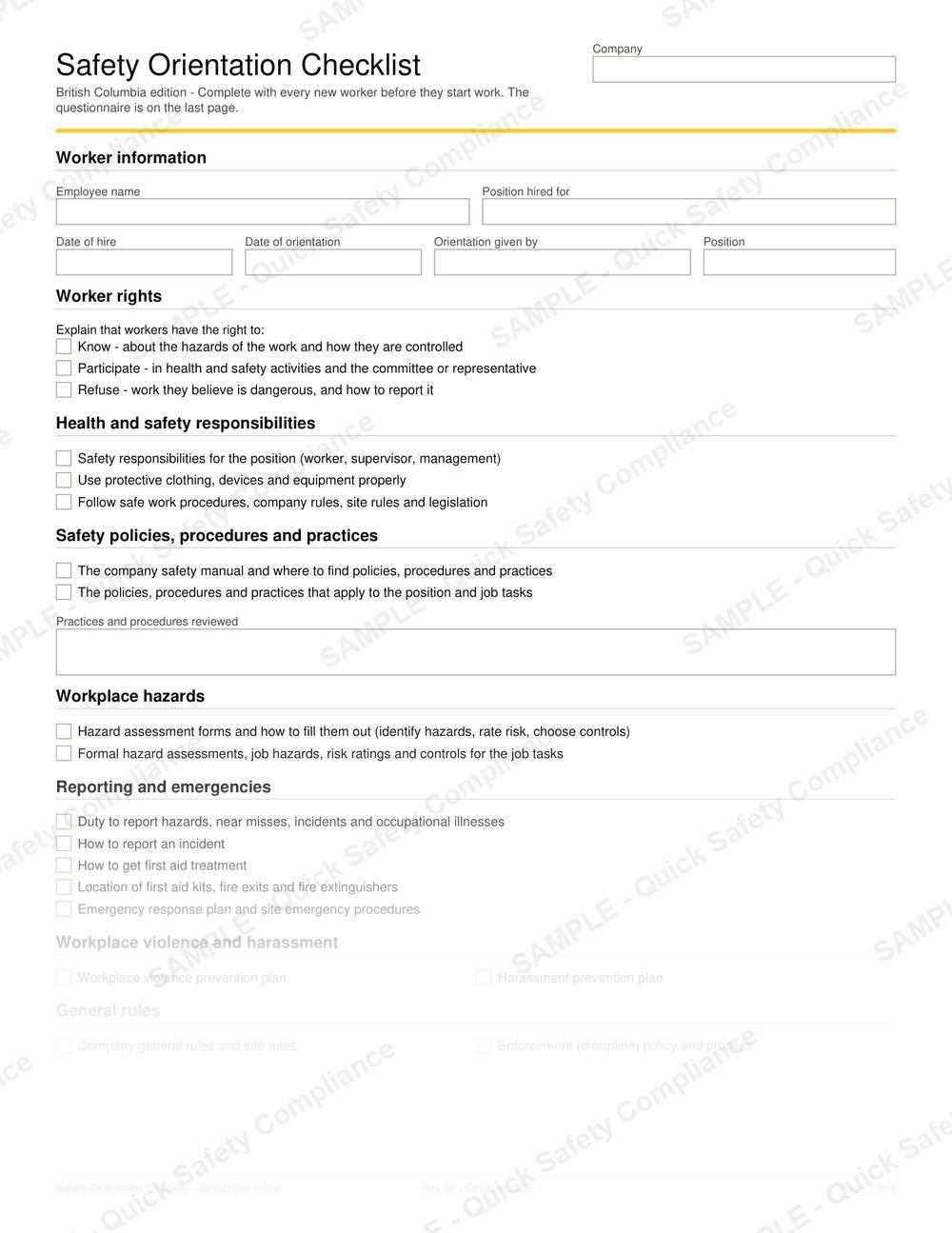
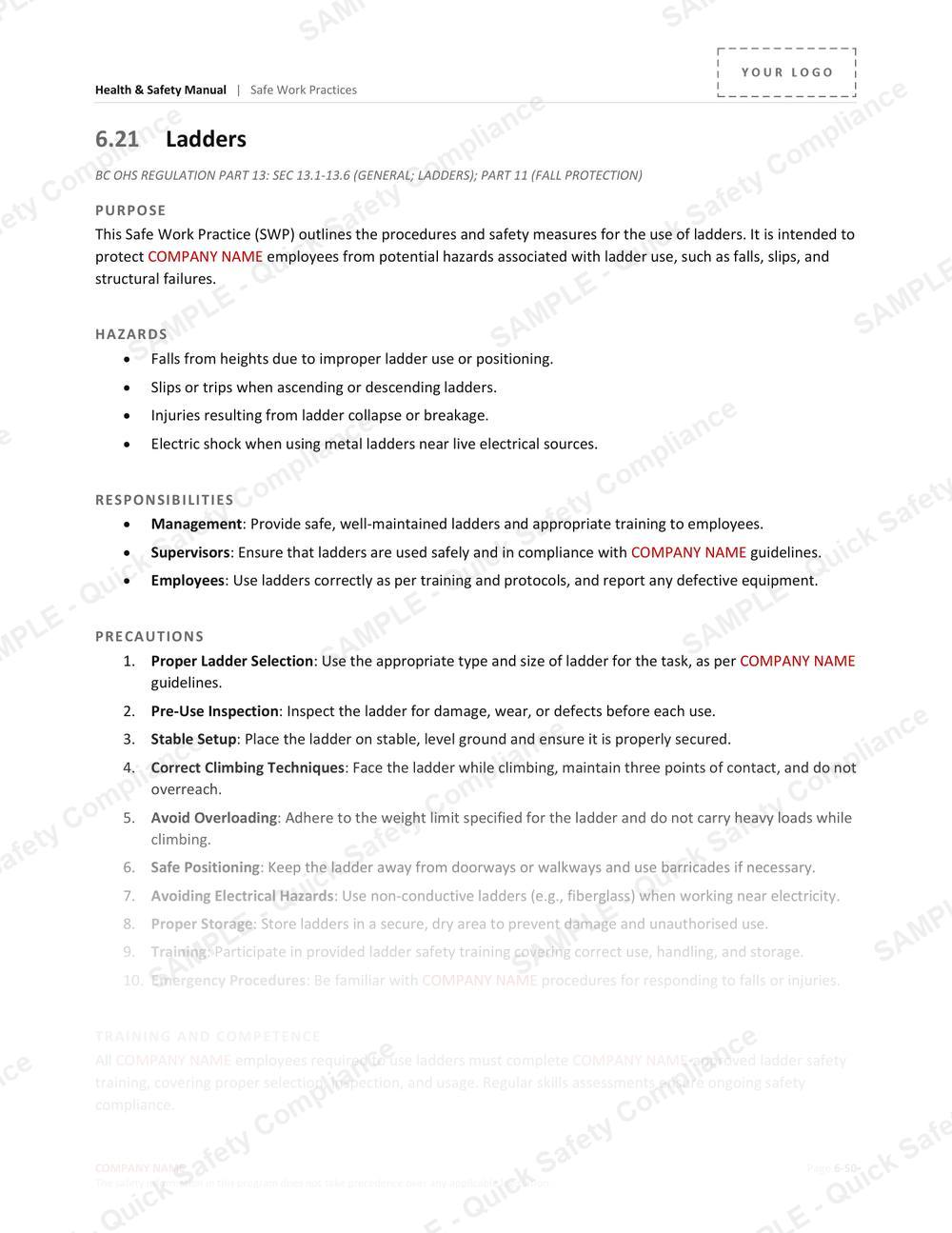
Real pages from the files you download. Tap a page to see it full size. From: British Columbia Construction Safety Manual.
Prime contractors and multiple-employer sites
A multiple-employer workplace is one where workers of 2 or more employers are working at the same time (Workers Compensation Act, s. 13). Its prime contractor is the directing contractor, employer or other person who agrees in writing with the owner to be the prime contractor or, if there is no written agreement, the owner.
The prime contractor must ensure that the health and safety activities of everyone at the workplace are coordinated, and do everything reasonably practicable to establish and maintain a system or process that ensures compliance (s. 24(1)). Each employer must give the prime contractor the name of the person it has designated to supervise its workers there (s. 24(2)).
Part 20 of the Regulation adds that each employer notifies the owner or prime contractor in advance of any work likely to create a hazard for another employer's workers, and where overlapping work creates hazards and the combined workforce is more than 5, a qualified coordinator is appointed (s. 20.3).
Notice of project
The owner, or the prime contractor the owner engages, must ensure WorkSafeBC receives written notice at least 24 hours before work begins on a construction project, and post the notice at the site, when any of these applies (s. 20.2):
- The estimated total cost of labour and materials is more than $100 000.
- The project is designed by a professional engineer, other than pre-engineered or pre-manufactured components.
- New erection, major alteration, structural repair or demolition of a building more than 2 storeys or 6 metres high, a bridge, an earth or water retaining structure more than 3 metres high, or a silo, chimney or similar structure more than 6 metres high.
- Workers will work in a cofferdam or a compressed air environment.
- A worker may need to enter a trench more than 30 metres long, or an excavation other than a trench more than 1.2 metres deep.
Fall protection and excavations
- Fall protection is required from 3 metres, or any lesser height where a fall involves a risk of injury greater than impact on a flat surface (s. 11.2).
- A written fall protection plan is required where workers are not protected by permanent guardrails and a fall of 7.5 metres or more may occur (s. 11.3).
- Before a worker enters an excavation more than 1.2 metres deep, or comes closer to the side than its depth, the sides are sloped, benched or supported as Part 20 sets out (s. 20.81).
- An excavation more than 6 metres deep, next to a structure, in ground subject to vibration or hydrostatic pressure, or where the ground slopes away steeply from the edge, follows the written instructions of a qualified registered professional (s. 20.78).
- Underground utility services are located accurately before excavating or drilling with powered equipment (s. 20.79).
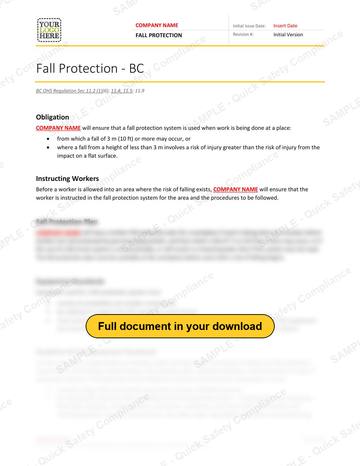
Fall Protection RAVS - British Columbia
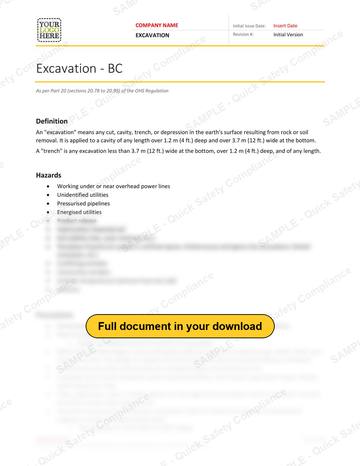
Excavations RAVS - British Columbia
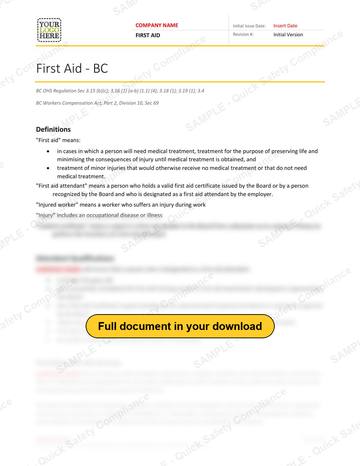
First Aid RAVS - British Columbia
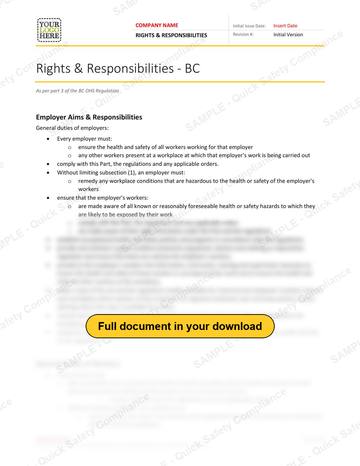
Rights & Responsibilities RAVS - British Columbia
Reporting and investigating incidents
WorkSafeBC must be told immediately of an accident that causes serious injury or death, a major structural failure or collapse, a major release of a hazardous substance, or a fire or explosion with potential for serious injury (Workers Compensation Act, s. 68).
The employer investigates reportable accidents, incidents that needed medical treatment and near misses with potential for serious injury (s. 69): a preliminary investigation within 48 hours (s. 71) and a full investigation report to WorkSafeBC within 30 days (s. 72). Work-related injuries are reported on the employer's report of injury within 3 days (s. 150).
How the BC construction manual covers it
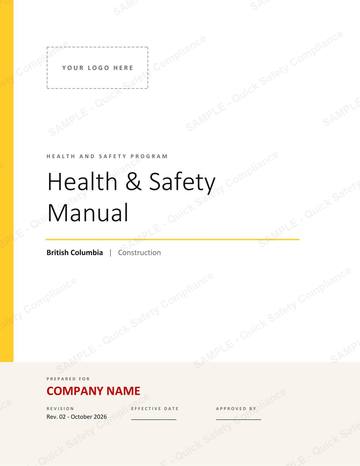
The BC construction manual is written to the Workers Compensation Act and the OHS Regulation, with 39 safe work practices, inspection and orientation forms, incident investigation and the committee section, for $499. The British Columbia Complete Program adds the BC RAVS library for $649.
Read the legislation
Official sources
- BC OHS Regulation, Part 3: rights and responsibilities (programs, inspections, first aid, new workers)
- BC OHS Regulation, Part 11: fall protection
- BC OHS Regulation, Part 20: construction, excavation and demolition
- BC Workers Compensation Act, Part 2: occupational health and safety
- BC OHS Regulation, Part 4: general conditions (including working alone)
Questions
My company has 12 workers. Do I need a written program in BC?
Section 3.1 does not require a formal program below 20 workers, but section 3.2 requires a less formal program with monthly safety meetings and a record of each one. Clients and general contractors usually ask for the written program anyway.
Who files the notice of project?
The owner, or the person the owner engages as prime contractor, at least 24 hours before work begins, and the notice is posted at the site (s. 20.2).
Who is the prime contractor if nobody signed an agreement?
The owner of the workplace (Workers Compensation Act, s. 13).
Get the document today
See every section before you pay, download it in minutes and make it yours with your company name and logo.