Alberta construction safety program requirements: what the law asks for
In Alberta, a construction employer that regularly employs 20 or more workers, or is directed to by a Director, must establish and implement a health and safety program (OHS Act, s. 16), and every construction work site with 2 or more employers must have a prime contractor (s. 10). Smaller contractors are not off the hook: every employer must assess the work site for hazards before work begins, write the assessment down and control what it finds (OHS Code, Part 2), protect workers who could fall 3 metres or more, and report serious incidents. Below is what each rule means on a construction job, with the section to look up.
By Quick Safety Compliance · · 6 min read
Who needs a written health and safety program
Section 16 of the Occupational Health and Safety Act says an employer who regularly employs 20 or more workers, or who is directed to by a Director, must establish and implement a health and safety program, subject to the OHS Code. Head count is the trigger, not the size of the job or the trade.
Below 20 workers there is no stand-alone duty to have a program, but most of what a program contains is still required: written hazard assessments, emergency arrangements, first aid records, incident reports and the worker participation rules below. General contractors and prequalification platforms ask for a written program long before you reach 20 workers.
The same Act sets when you need a joint health and safety committee or a health and safety representative:
- Joint Health and Safety Committee
- An employer must establish a joint health and safety committee if it regularly employs 20 or more workers. Where 2 or more employers together have 20 or more regularly employed workers at a work site with no prime contractor, they must co-ordinate one committee for the site.
- Health and Safety Representative
- An employer must designate a health and safety representative, who is a worker not associated with management, if it regularly employs 5 to 19 workers. An employer may choose to establish a committee instead.
- Fewer than 5 workers
- No committee or representative is required unless a Director designates the work site; the employer involves workers directly in hazard assessment and safety matters.
- Health and safety program
- An employer that regularly employs 20 or more workers must establish and implement a health and safety program (section 16).
(Sections 13, 14 and 16 of the OHS Act and Part 13 of the OHS Code set out these requirements.)
An OHS Director can require a committee or a representative at any work site.
Prime contractors on construction sites
Every construction work site and oil and gas work site must have a prime contractor if 2 or more employers are involved in work at the site (OHS Act, s. 10(1)). The person in control of the work site designates the prime contractor in writing (s. 10(2)).
The prime contractor's job is to coordinate health and safety among the employers on the site. If you are the prime contractor, your program needs a section on how you manage the other employers: what you collect before they start, how you orient them and how you check their work. If you are a subcontractor, expect it to ask for your hazard assessments, orientation records and safe work practices before you start.
Hazard assessment before work begins
Part 2 of the OHS Code is the backbone of an Alberta program. The employer must assess a work site and identify existing and potential hazards before work begins (s. 7(1)), prepare a report of the results and the methods used to control or eliminate the hazards (s. 7(2)), and record the date it was prepared or revised (s. 7(3)).
The assessment is repeated at reasonably practicable intervals, when a new work process is introduced, when a process or operation changes, and before significant additions or alterations to the site (s. 7(4)). Affected workers must be involved (s. 8). Hazards are eliminated where reasonably practicable; if not, they are controlled with engineering controls first, then administrative controls, then personal protective equipment, or a combination that gives greater safety (s. 9).
In practice: a formal hazard assessment for each type of work, kept on file, plus a field level hazard assessment at the start of each shift or task. Pages from the Alberta construction manual:
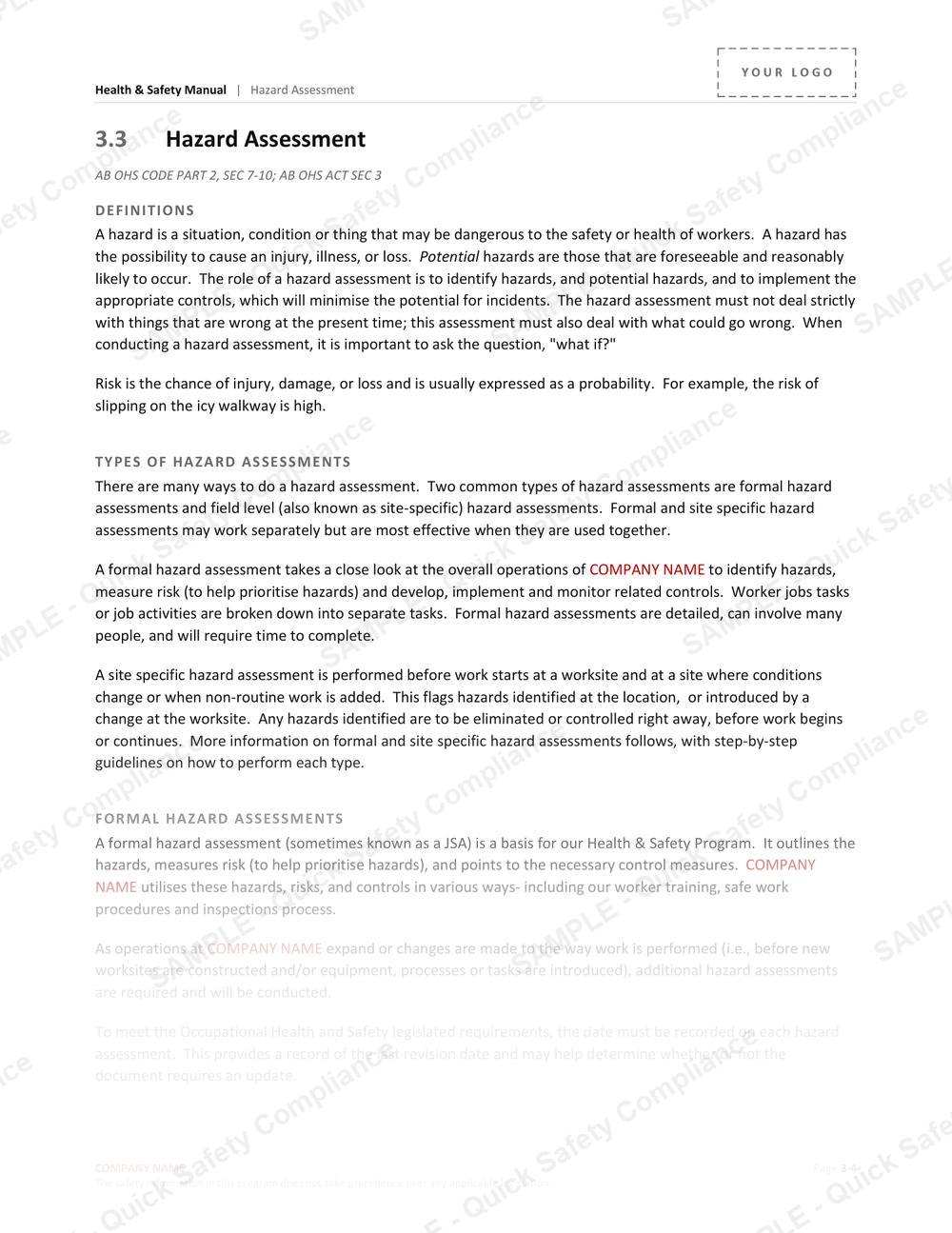
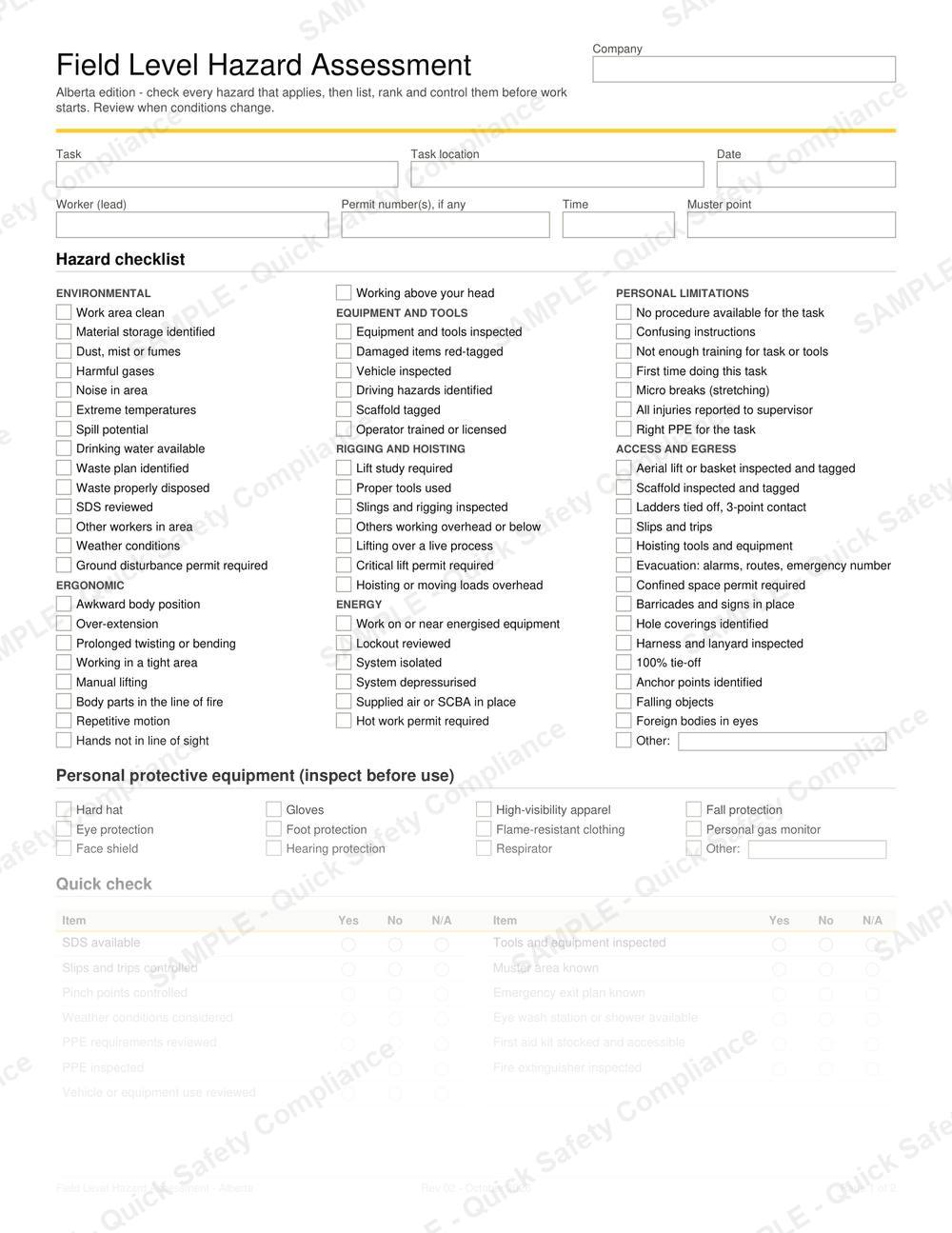
Real pages from the files you download. Tap a page to see it full size. From: Alberta Construction Safety Manual.
Fall protection, excavations and buried facilities
These are construction rules commonly checked on site. Each one belongs in your program as a safe work practice or code of practice, with the forms to prove it is followed.
- Fall protection is required where a worker may fall 3 metres or more, more than 1.2 metres at a permanent work area, or any distance where there is an unusual possibility of injury (OHS Code, s. 139).
- A written fall protection plan is required where a worker may fall 3 metres or more and is not protected by guardrails (s. 140).
- A worker on a portable ladder who may fall 3 metres or more must use a personal fall arrest system, except for light duty tasks of short duration that meet s. 137(3).
- Before a worker enters an excavation more than 1.5 metres deep and is closer to the wall than its depth, the walls are cut back, supported with a temporary protective structure, or both (s. 450).
- Spoil piles are kept with the leading edge at least 1 metre from the edge of the excavation (s. 453), and a trench more than 1.5 metres deep has a safe way in and out within 8 metres of each worker (s. 455).
- Before any ground disturbance, the owners of buried facilities are asked to locate and mark them, and no ground is disturbed until they are marked (s. 447 and 448).
Programs clients ask for by name
Clients and ISNetworld often ask for these as separate written programs, at $9 each.
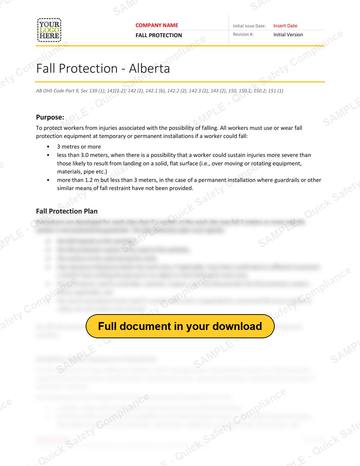
Fall Protection RAVS - Alberta
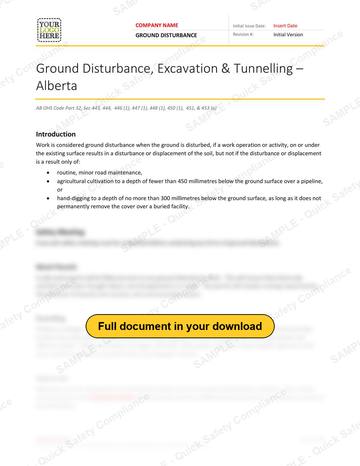
Ground Disturbance RAVS - Alberta
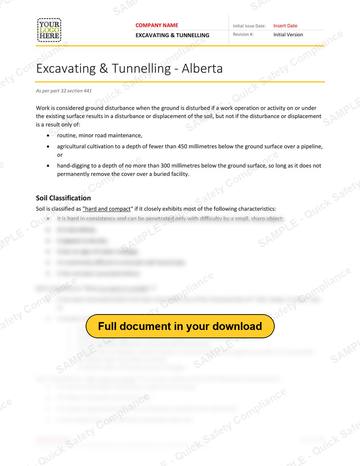
Excavation & Tunneling RAVS - Alberta
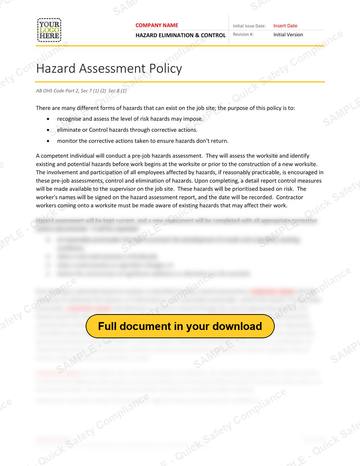
Hazard Assessment Elimination & Control RAVS - Alberta
Reporting serious incidents
Section 33 of the OHS Act requires the prime contractor or, if there is none, the employer to report certain injuries and incidents to Alberta OHS as soon as possible: a death, an injury or illness where the worker has been or will be admitted to hospital beyond treatment in an emergency room or urgent care, an unplanned or uncontrolled explosion, fire or flood that causes or could cause serious injury, the collapse or upset of a crane, derrick or hoist, and the collapse or failure of a structural component of a building or structure.
Each of these is investigated, a written report with the corrective action taken is prepared, and the report is kept for at least 2 years (s. 33(6) and (7)). The scene is not disturbed except to help injured people, prevent further injury or protect endangered property. Separately, injuries that disable a worker beyond the day of the accident or need medical treatment beyond first aid are reported to WCB-Alberta within 72 hours (Workers' Compensation Act, s. 33(1)).
Worker rights your program has to describe
Every Alberta worker may refuse work they believe on reasonable grounds is an undue hazard (OHS Act, s. 17). When a worker refuses, the employer informs the committee or representative and, if the hazard is not fixed right away, inspects it, takes action to fix it and gives the worker a written report. Another worker is not assigned the refused work until the employer determines there is no undue hazard (s. 17(10)). No one may take disciplinary action against a worker for acting in compliance with the Act (s. 18).
Your orientation should cover these rights, and the Workplace Posters in the Implementation Kit includes text for a Right to Refuse Unsafe Work poster.
How the Alberta construction manual maps to these rules
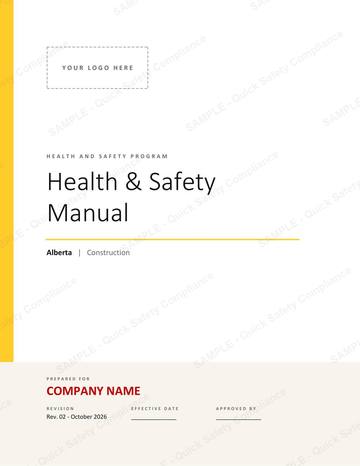
The Alberta construction manual cites the OHS Act and OHS Code by part and section, and includes 39 safe work practices, the hazard assessment program and forms, emergency response, incident investigation and the committee section, for $499. The Alberta Complete Program adds the whole Alberta RAVS library for $699.
Read the legislation
Official sources
- Alberta OHS Act, Part 1: general obligations, including prime contractors (s. 10)
- Alberta OHS Act, Part 2: committees, representatives and programs (s. 13 to 16)
- Alberta OHS Code, Part 2: hazard assessment, elimination and control
- Alberta Occupational Health and Safety Code (King's Printer)
- Alberta Workers' Compensation Act (King's Printer)
Questions
Do I need a written safety program with fewer than 20 workers in Alberta?
The Act only requires a program at 20 or more regularly employed workers, or when a Director directs it. You still need written hazard assessments and the other records the OHS Code requires, and most clients ask for a written program regardless of size.
Who designates the prime contractor?
The person in control of the work site designates the prime contractor in writing (OHS Act, s. 10(2)). On most commercial jobs that is the owner or the general contractor.
Is a field level hazard assessment enough on its own?
No. The OHS Code requires a hazard assessment before work begins, written down and dated. A field level assessment covers the task in front of the crew that day; the formal assessment covers the job as a whole and is the one you repeat when the work changes.
Does the manual replace a fall protection plan?
No. The manual contains the fall protection program and a fillable fall protection plan form, but the plan itself is written for the work site wherever a worker could fall 3 metres or more and is not protected by guardrails (OHS Code, s. 140).
Get the document today
See every section before you pay, download it in minutes and make it yours with your company name and logo.