Formal hazard assessment vs field level hazard assessment (FLHA)
A formal hazard assessment looks at a job, task or work site as a whole, rates the hazards and sets the controls, and is kept on file and repeated when the work changes; a field level hazard assessment (FLHA) is completed by the crew at the start of each shift or task to catch the hazards of that day and that location. You need both: the law requires an assessment before work begins and when it changes (in Alberta, OHS Code s. 7), and the FLHA is how most companies show that assessment reaches the crew every day. Here is how each one works and how they fit together.
By Quick Safety Compliance · · 4 min read
The formal hazard assessment
Start from a list of the jobs and tasks your company does. For each one, list the hazards, rate how likely and how severe each is, and set the controls, starting with elimination, then engineering controls, then administrative controls such as procedures and training, and finally PPE. Name who did the assessment, which workers took part, and date it.
Repeat it on a schedule and whenever something changes: new equipment, a new process, a new type of site, or an incident that shows a hazard was missed. The formal assessment is the source of your safe work practices, your training needs and your PPE list.
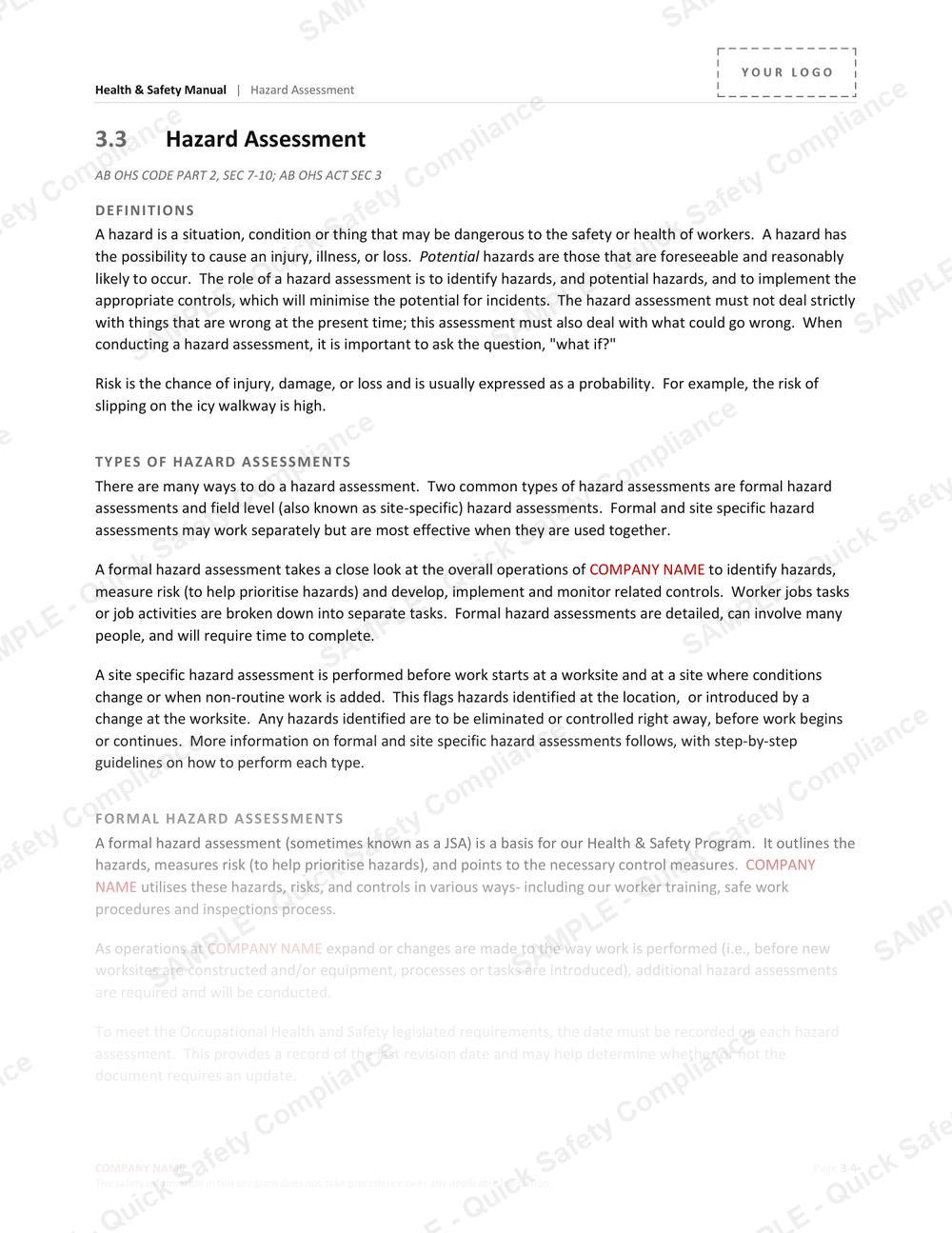
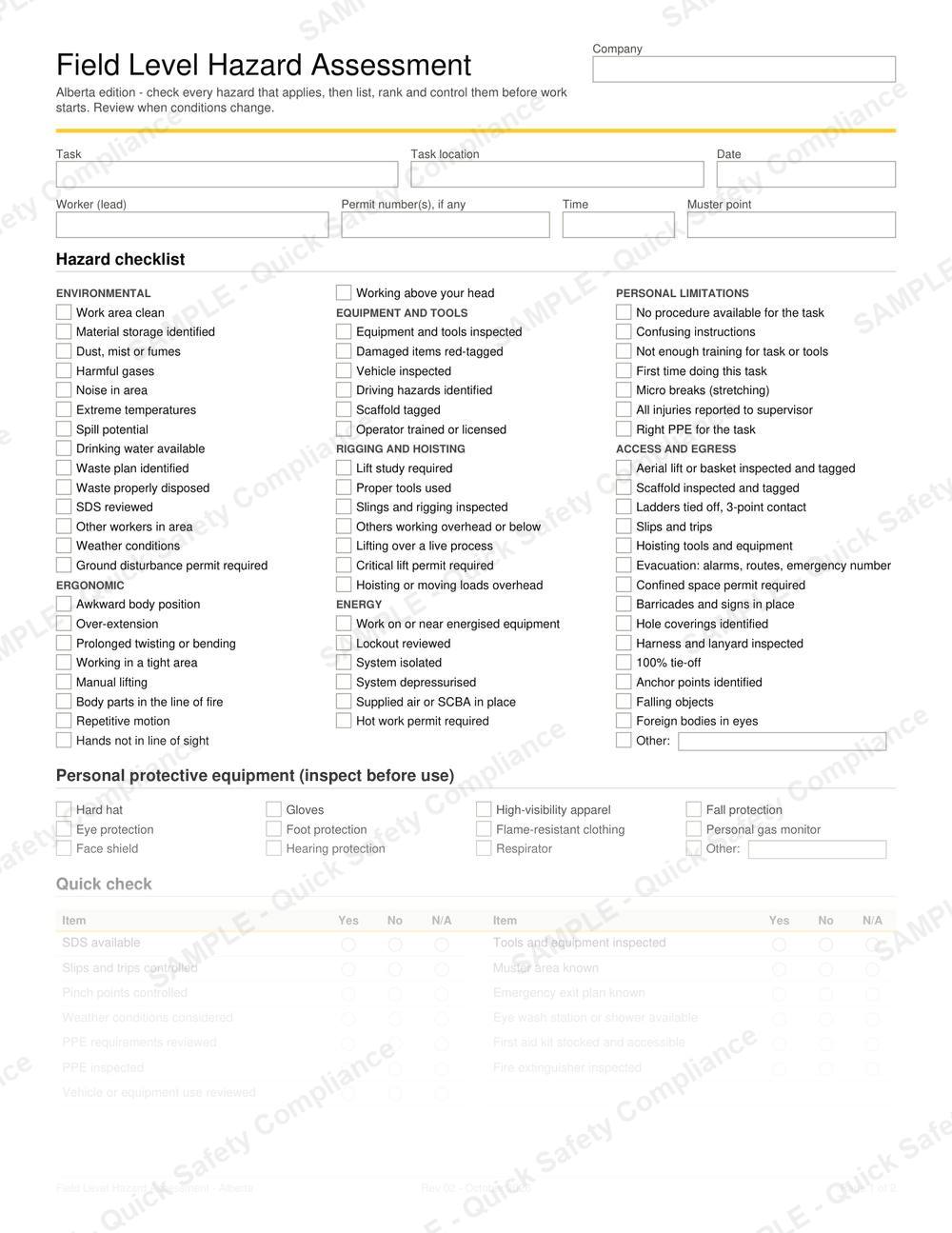
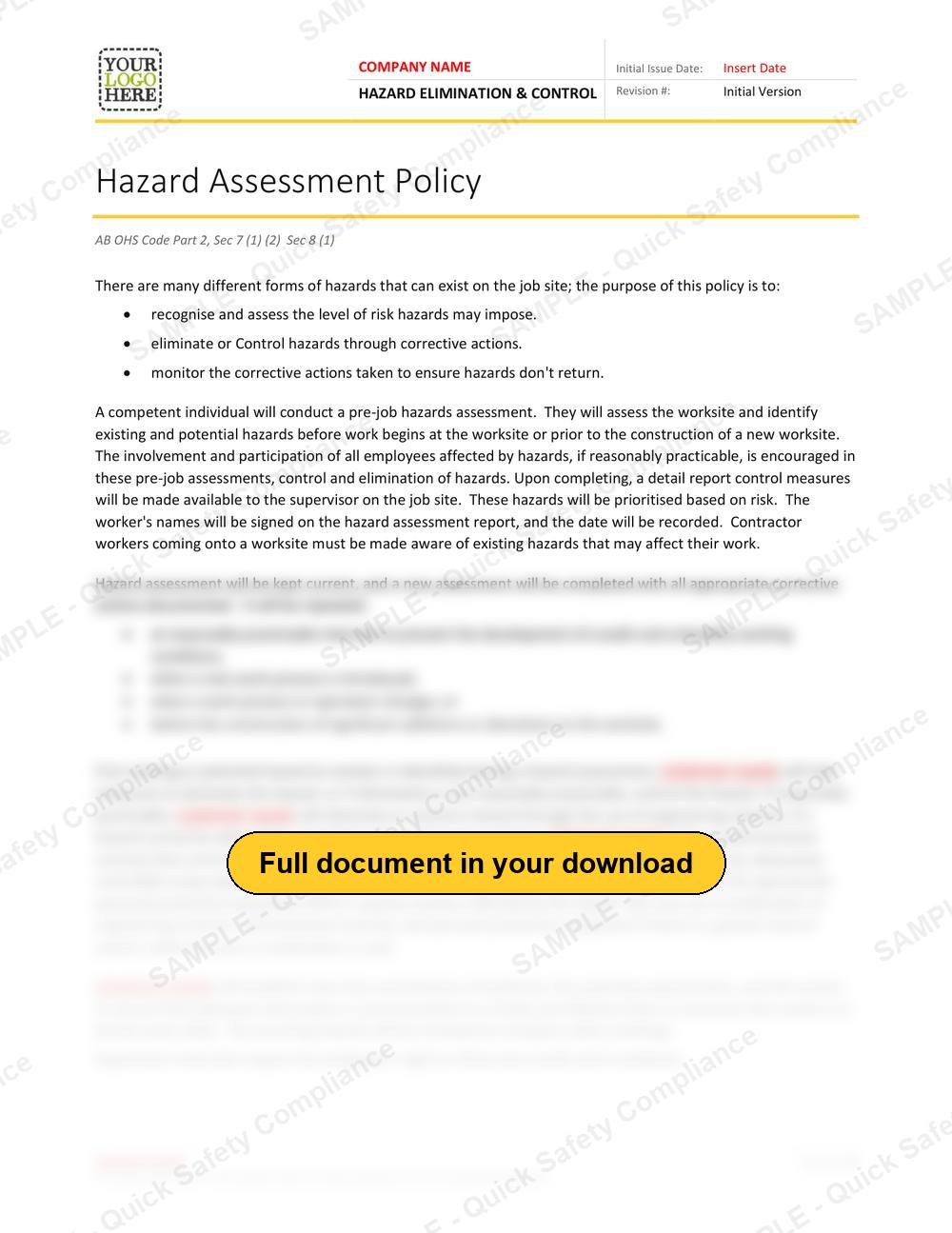
Real pages from the files you download. Tap a page to see it full size. From: Alberta Oil and Gas Safety Manual, Hazard Assessment Elimination & Control RAVS - Alberta.
The field level hazard assessment
The FLHA is done by the crew, at the work location, before the work starts and again when conditions change during the shift. It asks: what are we doing today, what is different here (weather, ground, traffic, other crews, overhead lines), what could go wrong, and what are we doing about it. Everyone on the crew signs it, and the supervisor reviews it.
A good FLHA is short, specific to the place and the day, and leads to an action. One that lists the same generic hazards every day is a sign that nobody is reading it.
What the law asks for
- Alberta: assess a work site and identify existing and potential hazards before work begins, prepare a written report with the controls, date it, repeat it at reasonably practicable intervals and when the work or site changes, and involve affected workers (OHS Code, s. 7 and 8). Eliminate hazards, or control them in the order the Code sets (s. 9).
- British Columbia: regular inspections of workplaces, equipment and work methods at intervals that prevent unsafe conditions from developing (OHS Regulation, s. 3.5), and identification of hazards before a worker is assigned to work alone (s. 4.20.2).
- Saskatchewan: a required program identifies existing and potential risks and the measures to reduce, eliminate or control them (OHS Regulations, 2020, s. 3-11(1)(b)).
- Ontario: the employer takes every precaution reasonable in the circumstances (OHS Act, clause 25 (2) (h)) and assesses the risks of workplace violence (s. 32.0.3); a supervisor advises workers of any potential or actual danger (clause 27 (2) (a)).
Rating the risk
Most formal assessments score each hazard on two scales, how likely it is to cause harm and how bad the harm could be, and combine them into a risk rank that tells you what to deal with first. Keep the scale simple enough that two supervisors would give the same answer, write down what each level means, and use the same scale across the company.
Score the hazard twice: before controls, to decide how much effort it deserves, and after controls, to check the remaining risk is acceptable. If the remaining risk is still high, the controls are not enough, and the task needs a better control, closer supervision or a permit before it goes ahead.
How the two fit together
- The formal assessment sets the controls for the task; the FLHA checks they are in place today and adds anything new.
- Hazards that keep appearing on FLHAs belong in the formal assessment, with a permanent control.
- Incidents and near misses trigger a review of the formal assessment for that task.
- Supervisors review FLHAs during the shift, not at the end of the week.
Mistakes that show up in audits
- Formal assessments that are years old and do not match the work being done now.
- No record of which workers took part.
- Controls that stop at PPE without considering elimination or engineering controls.
- FLHAs completed after the work, or copied from yesterday.
- Hazards found on FLHAs with no follow-up action recorded.
Forms and programs
Every manual includes the hazard assessment program, a formal hazard assessment form and a fillable FLHA. If a client asks for the hazard assessment program on its own, the Alberta written program is $9.
Hazard Assessment Elimination & Control RAVS - Alberta
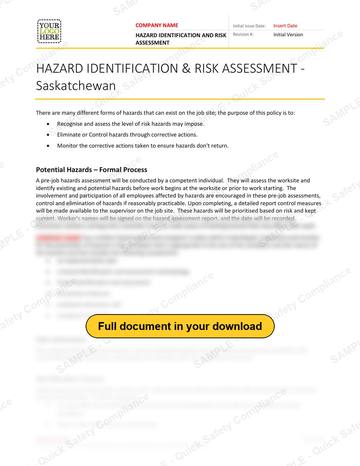
Hazard Identification and Risk Assessment RAVS - Saskatchewan
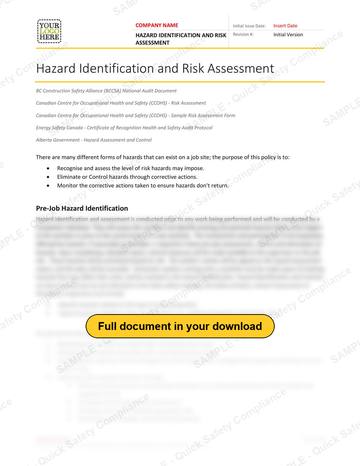
Hazard Identification and Risk Assessment RAVS - Canada Industry Practice
Read the legislation
Official sources
- Alberta OHS Code, Part 2: hazard assessment, elimination and control
- BC OHS Regulation, Part 3: rights and responsibilities (programs, inspections, first aid, new workers)
- The Occupational Health and Safety Regulations, 2020 (Saskatchewan Publications Centre)
- Ontario Occupational Health and Safety Act (e-Laws)
Questions
Is an FLHA required by law?
The term is not in most legislation. The law requires hazards to be assessed before work begins and when conditions change; the FLHA is the common way to show that happens at each task, and clients usually require it.
Who should complete the FLHA?
The workers doing the task, at the work location, with the supervisor reviewing it. Everyone on the crew signs it.
How often should the formal assessment be redone?
On a set schedule, such as yearly, and whenever the work, equipment or site changes, or an incident shows a hazard was missed. Date every revision.
Get the document today
See every section before you pay, download it in minutes and make it yours with your company name and logo.