Working alone rules by province: what each jurisdiction requires
Every Canadian jurisdiction expects an employer to protect a worker who works alone, but the detail differs. Alberta, British Columbia, Saskatchewan, Manitoba, New Brunswick, Prince Edward Island, Newfoundland and Labrador, the Northwest Territories and Nunavut have working alone rules in their regulations, and most require a hazard assessment plus an effective way to check on the worker; British Columbia, Prince Edward Island and Newfoundland and Labrador also require a written check-in procedure. Ontario, Nova Scotia and Yukon rely on the employer's general duty instead. Here is what each one says, with the section to cite in your working alone procedure.
By Quick Safety Compliance · · 5 min read
What every working alone procedure needs
Whatever the province, the same four pieces satisfy the rules and the people who check them: a hazard assessment of the work done alone, a way for the worker to call for help, a schedule for checking on the worker with a named person who does the checking, and a plan for what happens when a check-in is missed. Write it down, train the workers and the people checking on them, and keep the check-in records.
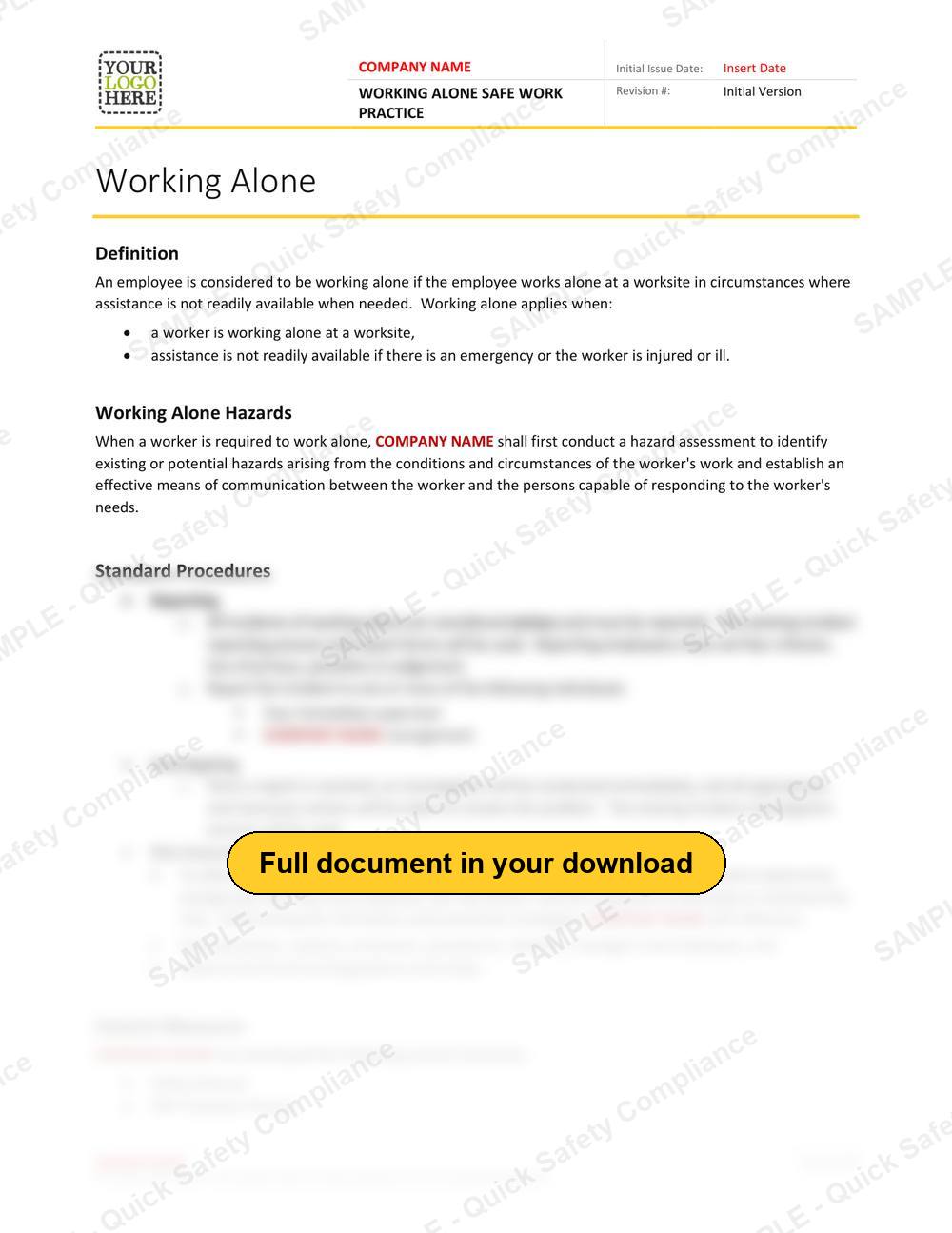
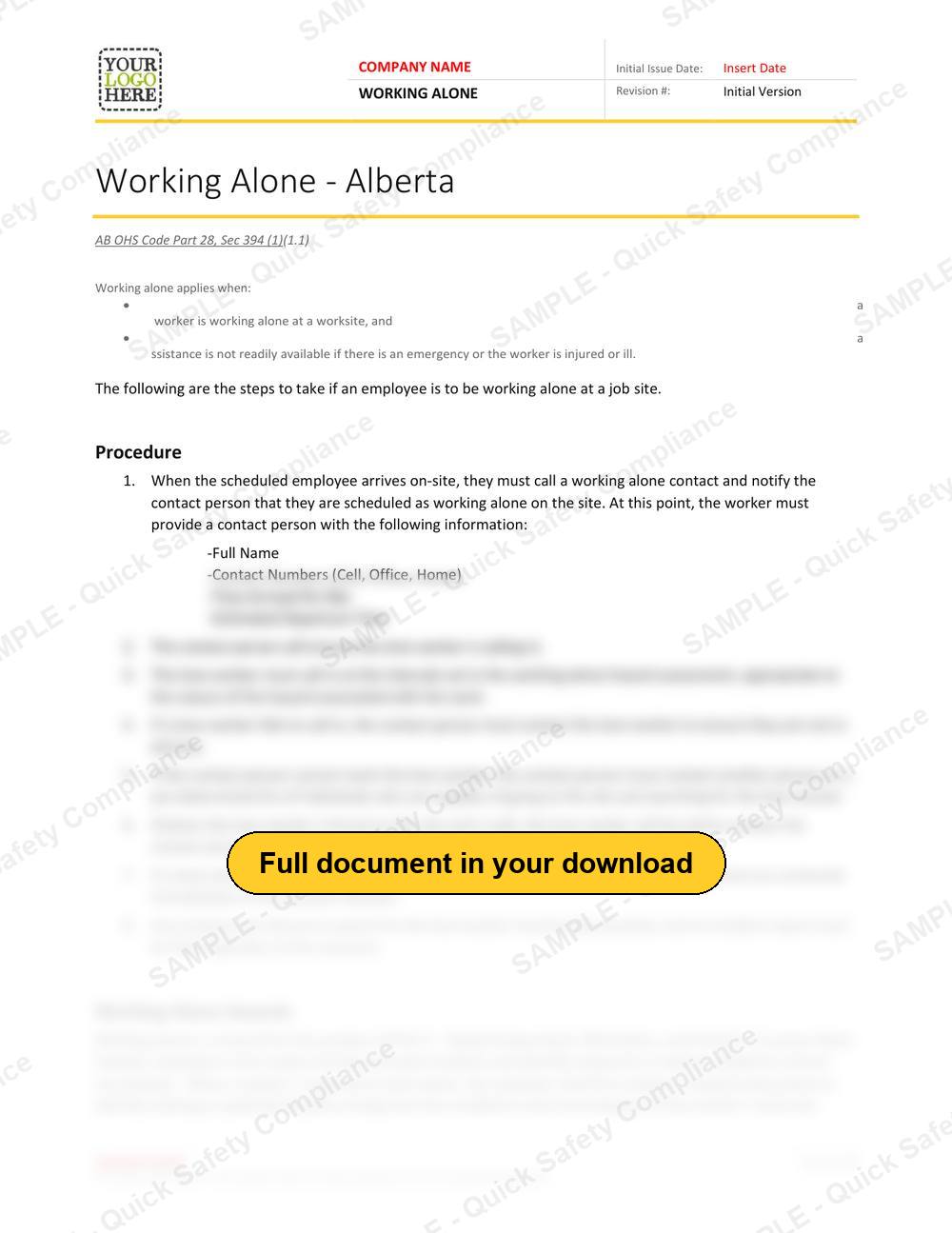
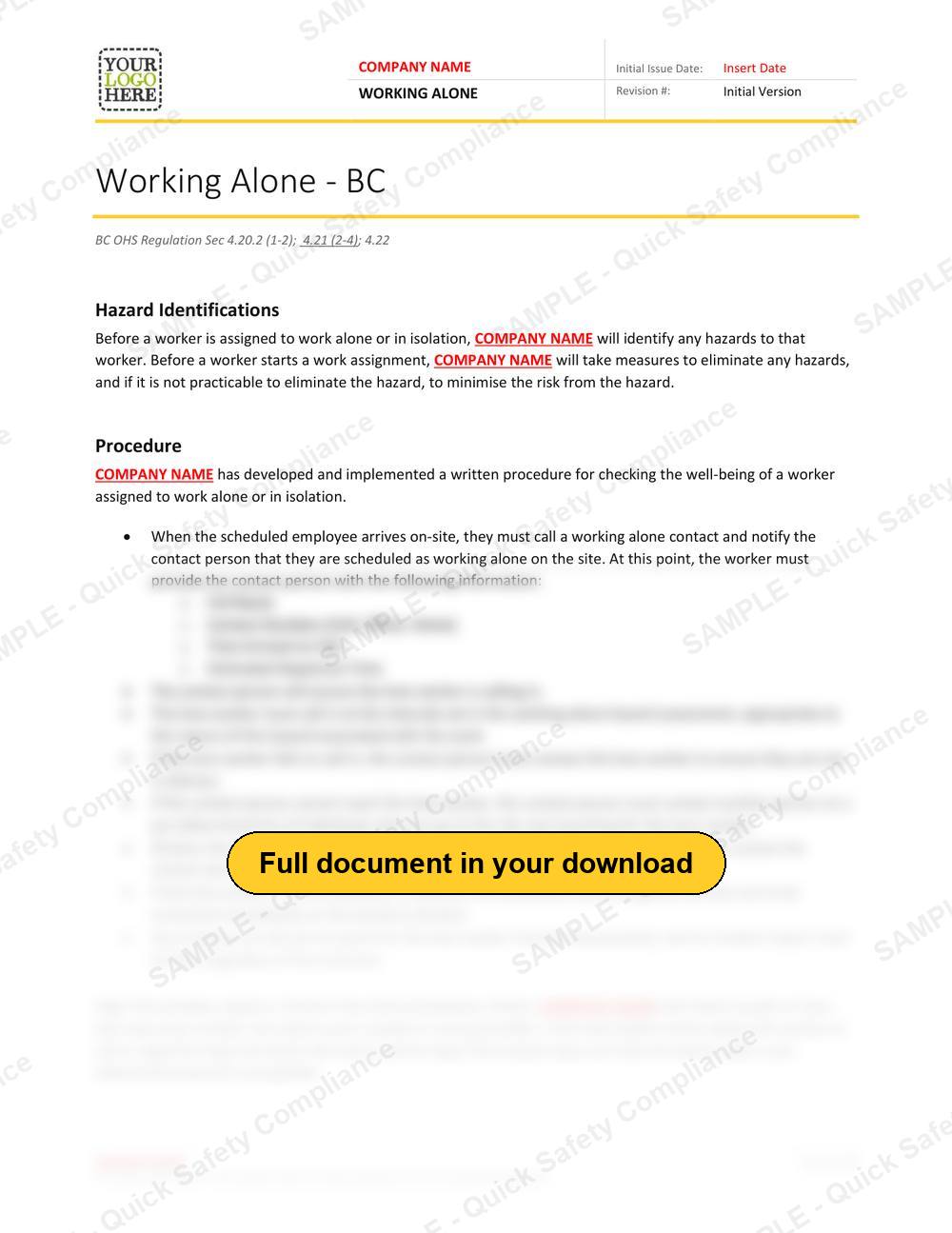
Real pages from the files you download. Tap a page to see it full size. From: Working Alone Safe Work Practice, Working Alone RAVS - Alberta, Working Alone RAVS - British Columbia.
Alberta
Part 28 of the OHS Code applies when a worker is working alone and assistance is not readily available if there is an emergency or the worker is injured or ill (s. 393(1)). Working alone is treated as a hazard for the hazard assessment rules in Part 2 (s. 393(2)), so it is assessed and controlled like any other hazard.
The employer provides an effective communication system, by radio, landline or cellular phone or another effective electronic means, with regular contact at intervals appropriate to the nature of the hazard (s. 394(1)). Where electronic communication is not practicable, the employer or a designate visits the worker, or the worker contacts the employer, at intervals set by the hazard (s. 394(1.1)). Retail fuelling outlets and convenience stores have additional rules in Part 27 (s. 392.1 to 392.6).
British Columbia
Before a worker is assigned to work alone or in isolation, the employer identifies the hazards and removes them or, if that is not practicable, reduces the risk (OHS Regulation, s. 4.20.2). The employer develops and implements a written procedure for checking the well-being of the worker, including the time between checks and what to do if the worker cannot be contacted (s. 4.21), with a check at the end of the shift as well as at regular intervals.
The worker and anyone assigned to check on them are trained in the procedure (s. 4.22), and the procedure is reviewed at least annually, or sooner if conditions change or it is found not to be working (s. 4.23). Late night retail has its own rules (s. 4.22.1).
Saskatchewan
To work alone means to work as the only worker of the employer or contractor at a worksite where assistance is not readily available in the event of injury, ill health or emergency (OHS Regulations, 2020, s. 3-24(1)). The employer identifies the risks in consultation with the committee, the representative or the workers, and takes all reasonably practicable steps to eliminate or reduce them.
Those steps must include an effective communication system by radio, phone or other effective means, and may include regular contact, limits on certain activities, minimum training or experience, and personal protective equipment (s. 3-24(4)).
Manitoba
Part 9 of the Workplace Safety and Health Regulation covers working alone or in isolation, with sections on risk identification (s. 9.2) and safe work procedures (s. 9.3). Working alone means performing any work function as the only worker for that employer at the workplace, without direct supervision by the employer or a supervisor the employer has designated (s. 1.1); working in isolation means working where assistance is not readily available in the event of injury, ill health or emergency.
Ontario, Nova Scotia and Yukon
- Ontario has no working alone regulation. The employer's duty to take every precaution reasonable in the circumstances (OHS Act, clause 25 (2) (h)) and the workplace violence risk assessment (s. 32.0.3) apply. On a construction project, no work is done in a trench unless another worker is working above ground nearby (O. Reg. 213/91, s. 225).
- Nova Scotia has no general working alone regulation. The employer's general duty in the OHS Act (s. 13) applies, and the Occupational Safety General Regulations cover a person working alone with a risk of drowning (s. 14(2)).
- Yukon has no separate working alone part. The employer must make efforts to check the health and safety of workers who might not be able to get help if injured (Workers' Safety and Compensation Act, s. 27(1)(f)), the employer's hazard assessments must take into account the location and circumstances in which work takes place (Workplace Health and Safety Regulations, s. 1.03.01(2)(c)), and isolated workplaces have first aid rules (s. 18.13).
Atlantic provinces and the other territories
- New Brunswick requires a code of practice for any employee who works alone at any time, setting out the workplace, the nature of the business, the risks, the procedures to minimise them and the means of getting emergency help, with the equipment provided and a training program for the employees and their supervisors (Code of Practice for Working Alone Regulation 92-133, s. 2 to 6).
- Prince Edward Island requires written working alone procedures with check-in intervals and an end-of-shift check, training, and a copy available to an officer (General Regulations, Part 53, s. 53.1 to 53.5).
- Newfoundland and Labrador requires a risk assessment and a written check-in procedure with set intervals and recorded contacts, developed in consultation and reviewed annually (OHS Regulations, 2012, s. 15).
- The Northwest Territories and Nunavut require the employer to identify the hazards of working alone or at an isolated work site in consultation with the committee, representative or workers, take reasonable measures to eliminate or reduce the risk, and provide an effective communication system (OHS Regulations, s. 33).
Templates and the check-in poster
The Working Alone safe work practice is $9, and provincial written programs are sold for Alberta, British Columbia and Saskatchewan. Every manual includes the Workplace Posters in its Implementation Kit, with the text for a Working Alone Check-In poster.
Working Alone Safe Work Practice
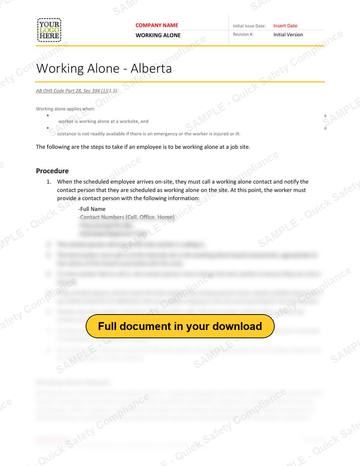
Working Alone RAVS - Alberta
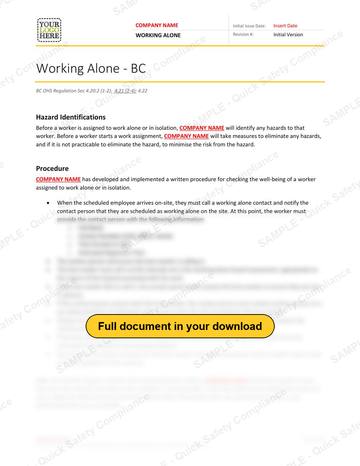
Working Alone RAVS - British Columbia
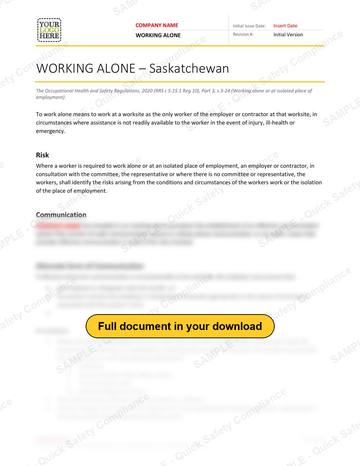
Working Alone RAVS - Saskatchewan
Read the legislation
Official sources
- Alberta OHS Code, Part 28: working alone
- BC OHS Regulation, Part 4: general conditions (including working alone)
- The Occupational Health and Safety Regulations, 2020 (Saskatchewan Publications Centre)
- Manitoba Workplace Safety and Health Regulation, M.R. 217/2006
- New Brunswick Code of Practice for Working Alone Regulation 92-133
- Prince Edward Island OHS Act General Regulations
- Newfoundland and Labrador Occupational Health and Safety Regulations, 2012
- Northwest Territories Occupational Health and Safety Regulations
- Nunavut Occupational Health and Safety Regulations
- Ontario Occupational Health and Safety Act (e-Laws)
- Nova Scotia Occupational Health and Safety Act
- Yukon Workers' Safety and Compensation Act
- Yukon Workplace Health and Safety Regulations, Part 18 (first aid)
Questions
How often should I check on a worker who works alone?
Most rules leave the interval to the hazard: Alberta requires contact at intervals appropriate to the nature of the hazard, and British Columbia requires the interval to be written into the procedure, with a check at the end of the shift. Set shorter intervals for higher-risk work and write the reason down.
Is a cell phone enough?
Only where it works. Alberta, Saskatchewan, the Northwest Territories and Nunavut require an effective communication system, so check coverage at the work location and use a radio, satellite device or scheduled visits where there is no signal.
Does Ontario require a working alone policy?
There is no working alone regulation in Ontario, but the general duty to take every reasonable precaution applies, and the risks of working alone belong in the workplace violence risk assessment. A written procedure is the simplest way to show you met that duty.
Get the document today
See every section before you pay, download it in minutes and make it yours with your company name and logo.