Saskatchewan oil and gas safety program requirements
In Saskatchewan, oil and gas drilling, well servicing with a rig and oilwell servicing are prescribed places of employment, so an employer there with 10 or more workers must establish a written occupational health and safety program (Saskatchewan Employment Act, s. 3-20; OHS Regulations, 2020, s. 3-11 and Table 7). The program has 10 required parts, from a policy statement to a review at least every 3 years, and it is designed with the occupational health committee, the representative or the workers. A worksite where 10 or more workers of 2 or more employers work in the oil and gas industry also needs a prime contractor (s. 33-2).
By Quick Safety Compliance · · 5 min read
Who needs a written program
Section 3-20 of The Saskatchewan Employment Act requires an employer at a prescribed place of employment to establish and maintain an occupational health and safety program. Section 3-11(2) of the Regulations prescribes the places in Table 7 that have 10 or more workers. Table 7 includes oil and gas drilling, well servicing with a rig, water well drilling and oilwell servicing, along with building construction, road construction, trucking and other industries.
The program must be in writing and available on request to the committee, the representative, the workers or an occupational health officer (Act, s. 3-20(4)), and it must be established and designed in consultation with the committee, the representative or, if there is neither, the workers (s. 3-20(2)). The director can also order a program at any place of employment.
The 10 things the program must contain
Section 3-11(1) of the Regulations lists them. Use them as your table of contents and you will not miss one:
- A statement of the employer's policy on protecting the health and safety of workers.
- The identification of existing and potential risks and the measures, including emergency procedures, to reduce, eliminate or control them.
- The internal and external resources, people and equipment, that may be needed to respond to an emergency.
- The responsibilities of the employer, supervisors and workers.
- A schedule for regular inspection of the place of employment and of work processes and procedures.
- A plan to control any biological or chemical substance handled, used, stored, produced or disposed of, and monitoring where appropriate.
- A plan for training workers and supervisors in safe work practices and procedures.
- A procedure to investigate accidents, dangerous occurrences and work refusals.
- A strategy for worker participation, including in inspections and investigations.
- A procedure to review and, if necessary, revise the program at intervals of no more than 3 years and whenever circumstances change.
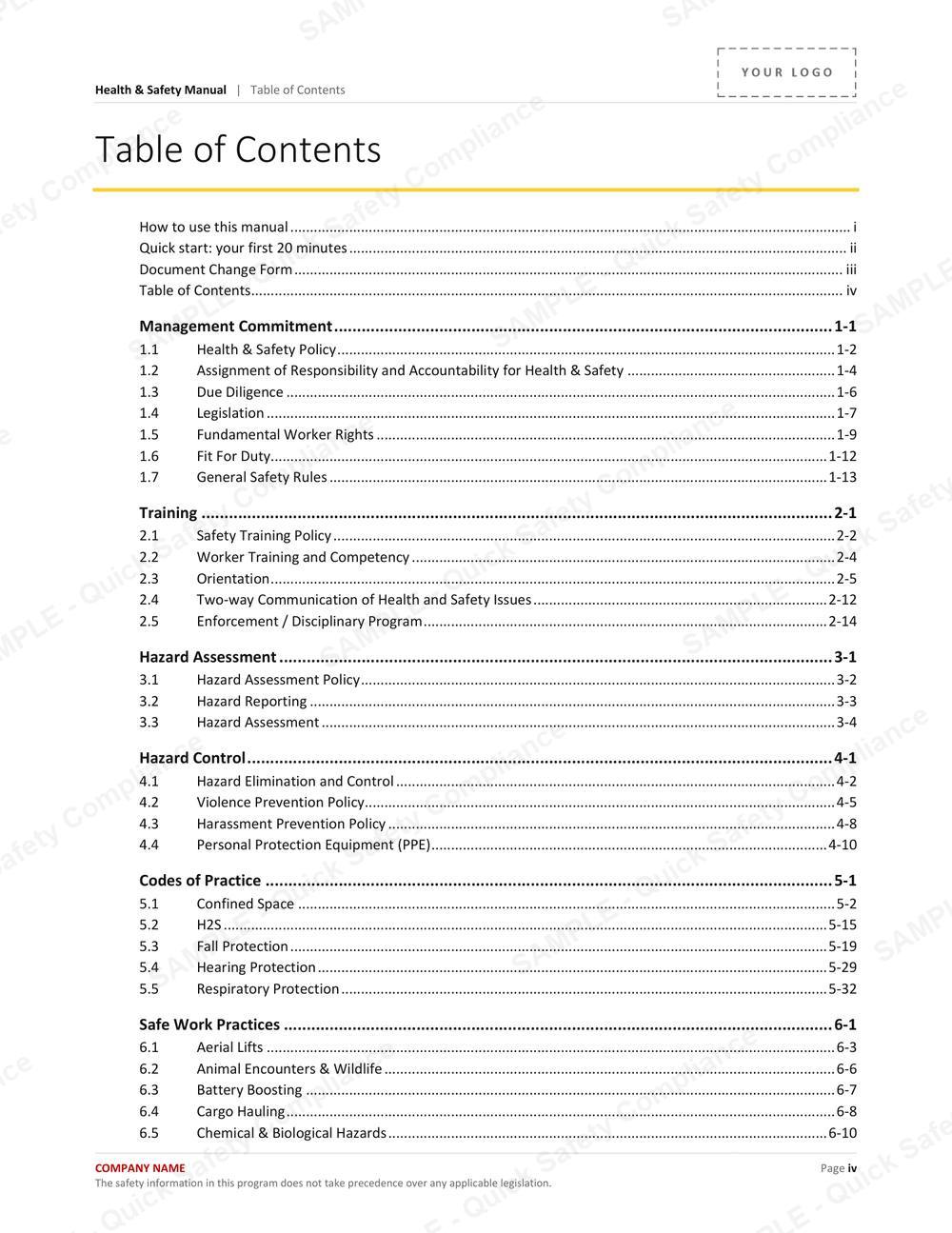
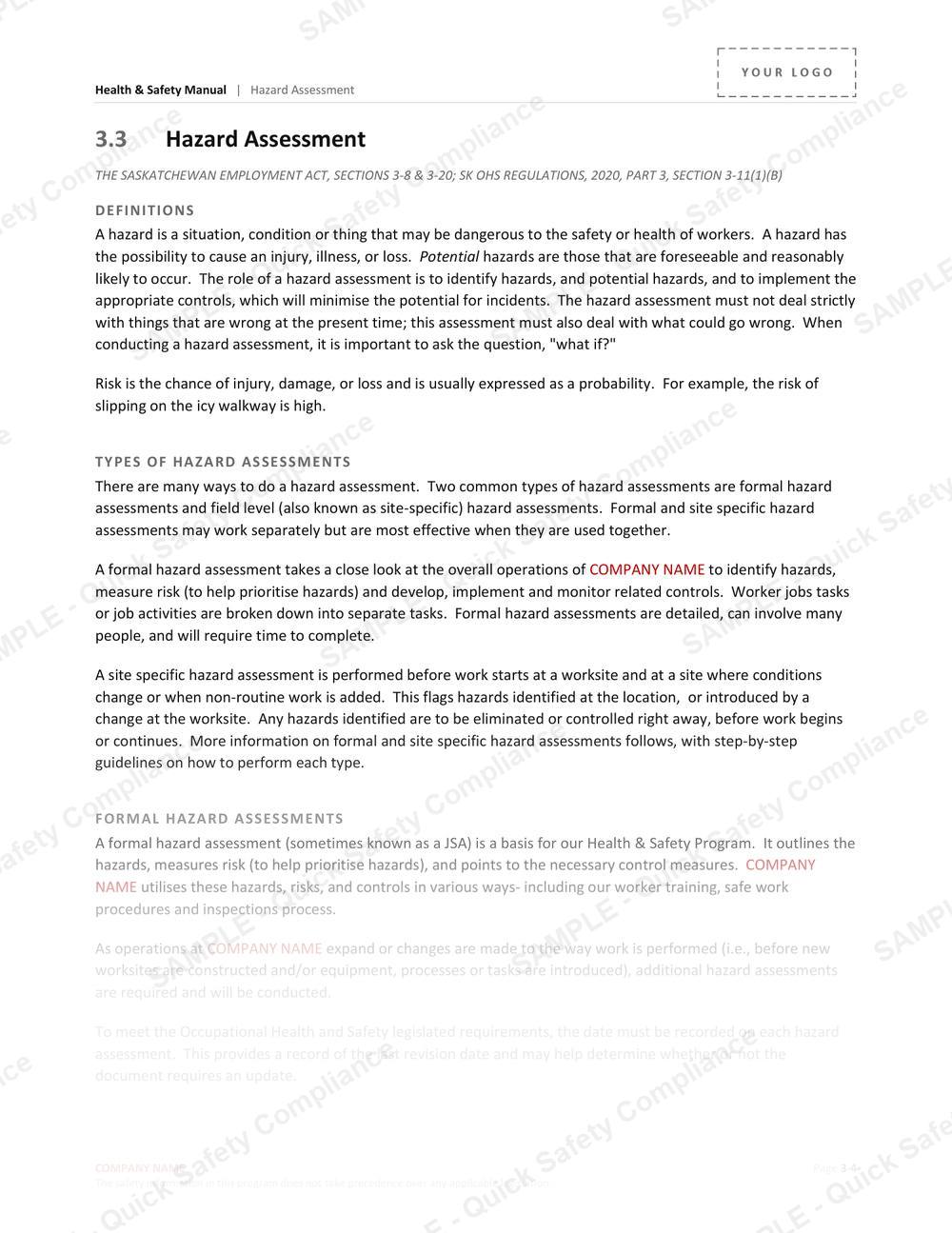
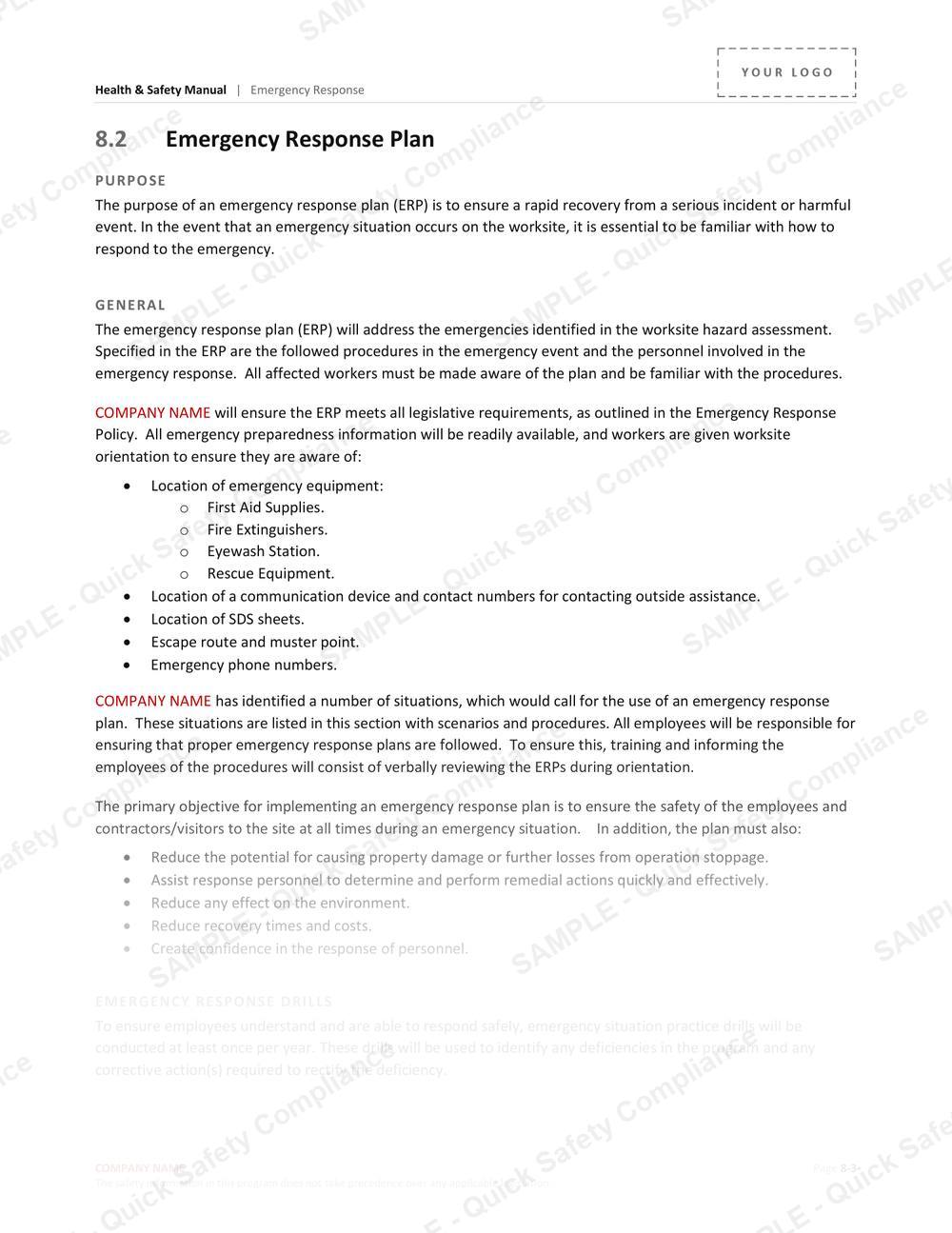
Real pages from the files you download. Tap a page to see it full size. From: Saskatchewan Oil and Gas Safety Manual.
Committees and representatives
An occupational health committee is required where 10 or more workers of one employer work (Act, s. 3-22). At a Table 7 place, which includes oil and gas drilling and well servicing, an employer with 5 to 9 workers needs an occupational health and safety representative (Act, s. 3-24; Regulations, s. 4-8). A committee decision on a work refusal must be a unanimous vote of the members present (Regulations, s. 4-3(3)).
(The Saskatchewan Employment Act, Part III, Division 4, and Part 4 of The Occupational Health and Safety Regulations, 2020)
Occupational Health Committee
Every place of employment where 10 or more workers of one employer work (Act s. 3-22). The committee has 2 to 12 members, and at least half represent workers other than management.
A construction site at which 10 or more workers or self-employed persons work or are likely to work for more than 90 days - the contractor establishes the committee (Regulations s. 4-1).
The director of occupational health and safety may order an additional or new committee in writing (Act s. 3-23).
Members are designated for a term of not more than 3 years and hold office until a successor is designated (Regulations s. 4-2).
Occupational Health and Safety Representative
More than 4 but fewer than 10 workers of one employer (5 to 9 workers) at a place of employment listed in Table 7 of the Regulations, which includes building construction, road construction and earthwork, oil and gas drilling and well servicing, oilwell servicing, forestry, trucking, farming and ranching, metal manufacturing and machining, forwarding and warehousing, mines and hospitals (Act s. 3-24; Regulations s. 4-8).
Prime contractors on oil and gas worksites
Part 33 of the Regulations makes a worksite a required worksite when 10 or more self-employed persons, or workers under the direction of 2 or more employers, are engaged there in the construction, forestry or oil and gas industry (s. 33-2(1)). For this Part the oil and gas industry means the drilling, operation and servicing of gas and oil wells regulated by Part 29.
The prime contractor is whoever agrees in writing with the owner to be the prime contractor or, without an agreement, the owner (s. 33-2(2)). Every employer at a required worksite designates a competent person as its designated supervisor and gives that name to the prime contractor (s. 33-3(4)). If you service wells for an operator, have that name and your program ready before you mobilise.
Rules that matter most on a lease
- Part 29 of the Regulations covers oil and gas well drilling, operation and servicing (s. 29-1 to 29-40), including a requirement that oil and gas supervisors know hydrogen sulphide detection and control (s. 29-3(2)(d)).
- The hydrogen sulphide contamination limits are 10 ppm as an 8-hour average and 15 ppm as a 15-minute average (Table 18).
- Fall protection is required at 3 metres, or less where a fall could cause injury (s. 9-2), with a written fall protection plan where a worker may fall 3 metres or more without a guardrail (s. 9-3).
- A worker who works alone or at an isolated place must have an effective communication system, by radio, phone or other effective means, after the risks are identified with the committee, representative or workers (s. 3-24).
- No one under 16 may work on a drilling or servicing rig (s. 3-3).
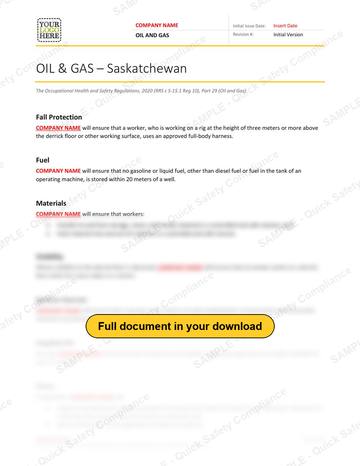
Oil and Gas RAVS - Saskatchewan
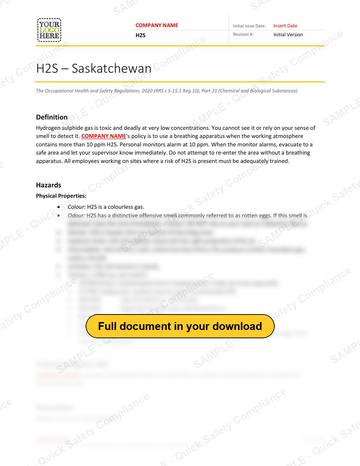
H2S RAVS - Saskatchewan
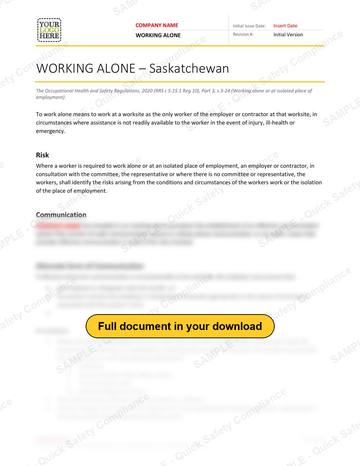
Working Alone RAVS - Saskatchewan

Subcontractor Management Plan RAVS - Saskatchewan
Reporting incidents
The Occupational Health and Safety Division is notified as soon as reasonably possible of an accident that causes or may cause a death, one that requires a hospital in-patient stay of 72 hours or more, and any dangerous occurrence, such as the failure of a crane or hoist, contact with an energised conductor or an uncontrolled release of a toxic or explosive substance (Regulations, s. 2-2 and 2-3).
Accidents that cause or may cause death, require an in-patient stay of 24 hours or more, and dangerous occurrences are investigated with a written report (s. 3-18 and 3-20). Work-related injuries needing medical attention are reported to the Saskatchewan Workers' Compensation Board within 5 days.
How the Saskatchewan oil and gas manual covers it
The Saskatchewan oil and gas manual is written to The Saskatchewan Employment Act and the 2020 Regulations, with 40 safe work practices (among them hot work, gas and atmosphere testing and working alone), an H2S code of practice and H2S release emergency plan, field forms and the committee section, for $499. The Saskatchewan Complete Program adds the Saskatchewan RAVS library for $649.
Read the legislation
Questions
We are a 6-person well servicing crew. Do we need a program?
Section 3-11 prescribes Table 7 places with 10 or more workers, so the program duty starts at 10. With 5 to 9 workers at a Table 7 place you need an occupational health and safety representative, and operators will still ask for your written program.
How often must the program be reviewed?
At intervals of no more than 3 years, and whenever circumstances change in a way that may affect worker health or safety (s. 3-11(1)(j)).
Does the manual cover H2S?
Yes. The Saskatchewan oil and gas manual includes an H2S code of practice and an H2S release emergency plan, and a stand-alone Saskatchewan H2S written program is $9 if a client asks for it separately.
Get the document today
See every section before you pay, download it in minutes and make it yours with your company name and logo.