Safe work practice vs safe work procedure vs code of practice: which do you need?
A safe work practice sets the general rules for doing a type of work safely, a safe work procedure lists the exact steps for one task, and a code of practice is a more formal written document that some provinces require for specific high-risk hazards. The law rarely uses the first two names, but it does expect written instructions: British Columbia's program must include written instructions available to all workers, Saskatchewan's must include a plan for training in safe work practices and procedures, and Alberta requires a code of practice for hazards such as hydrogen sulphide. Most companies need all three, matched to the work they actually do.
By Quick Safety Compliance · · 4 min read
Safe work practice
A safe work practice covers a type of work, a tool or a hazard in general terms: ladders, hot work, working alone, powered mobile equipment. It sets out the hazards, the rules everyone follows, the PPE and training needed, and what to inspect. It is written once for the company and applies wherever that work is done. Most of the safe work documents in a manual are practices, because one well-written practice covers many jobs.
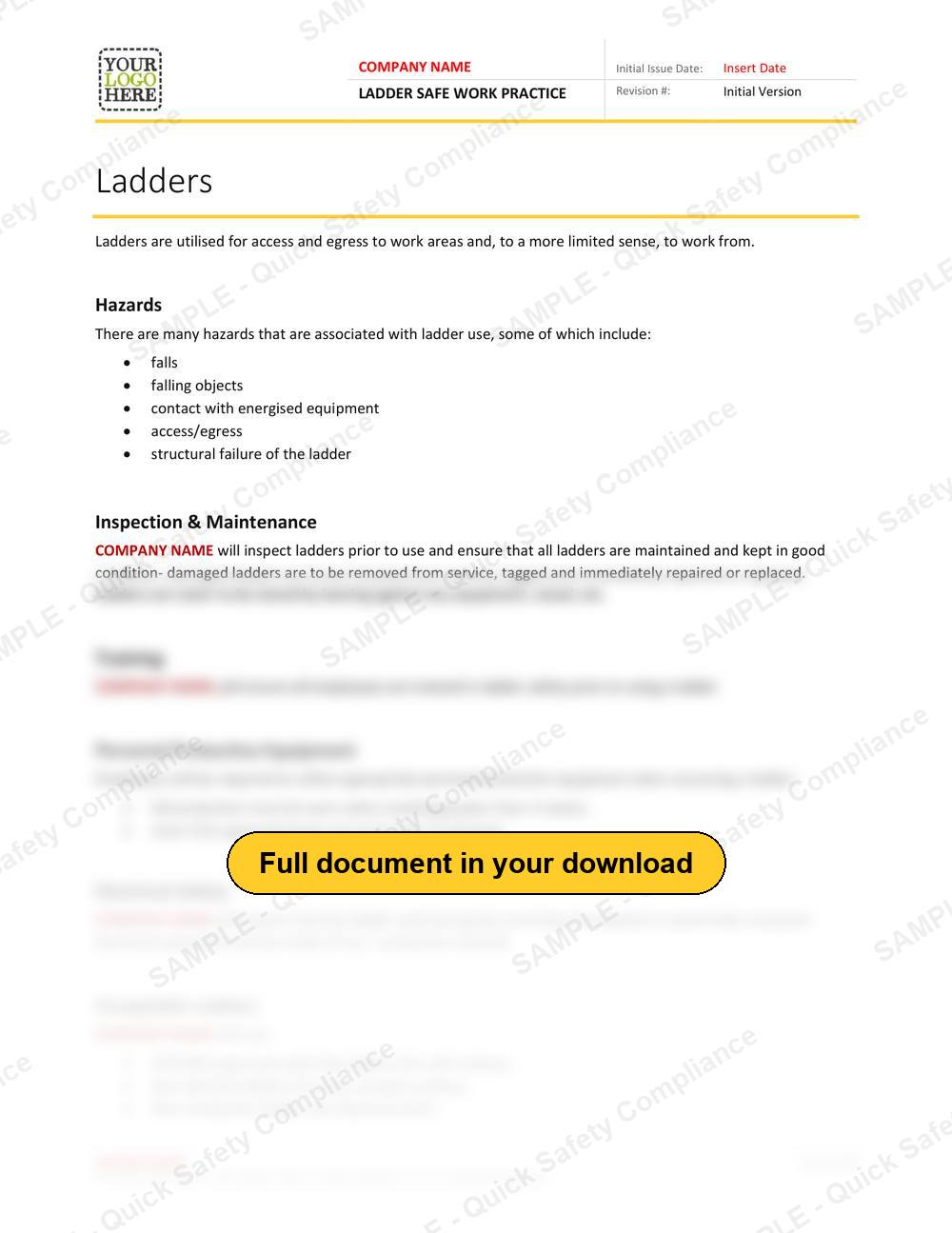
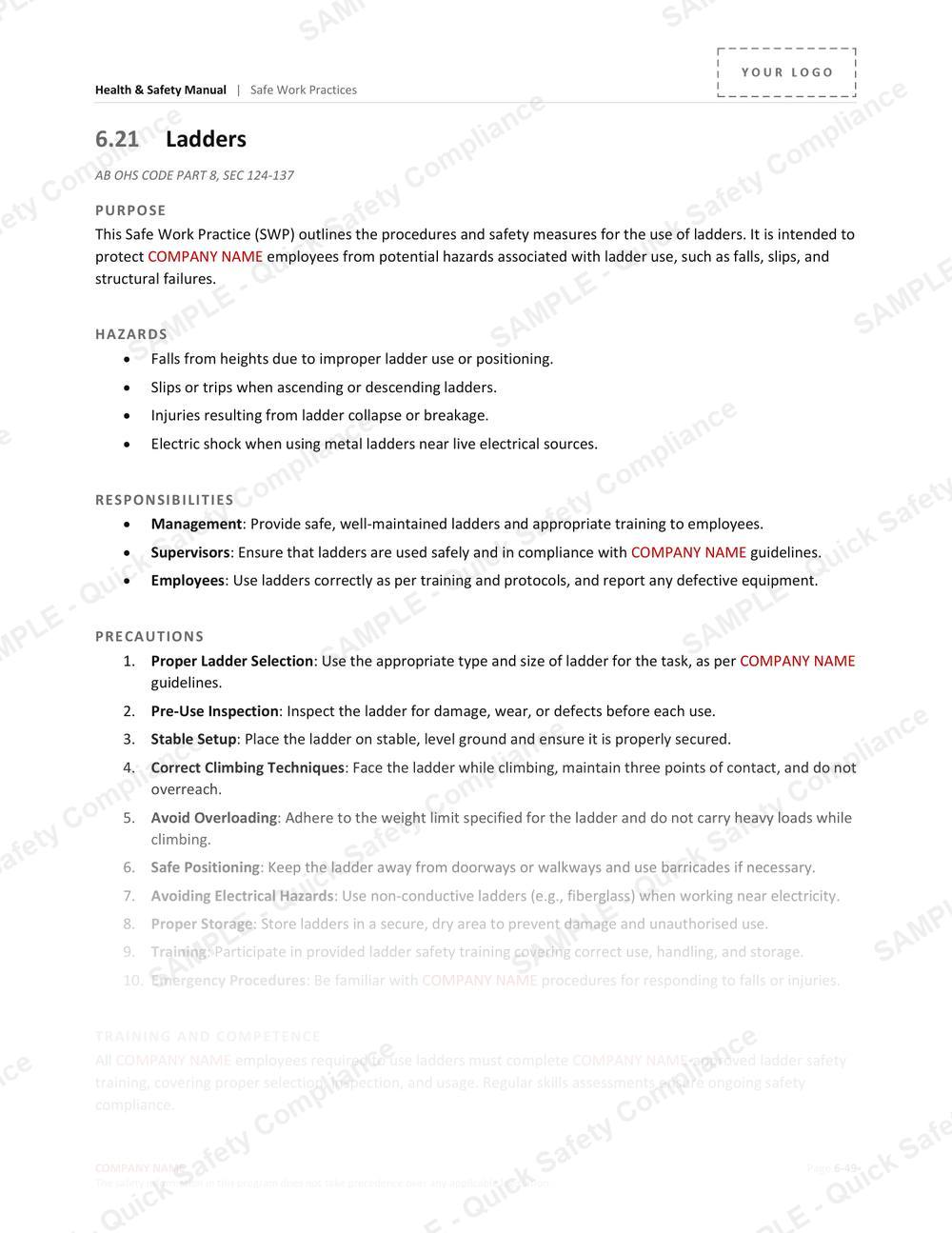
Real pages from the files you download. Tap a page to see it full size. From: Ladder Safe Work Practice, Alberta Construction Safety Manual.
Safe work procedure
A safe work procedure gives the exact steps, in order, for one task with one piece of equipment: isolating a particular machine, changing a blade on a specific saw, starting up a particular unit. Write a procedure where the order of the steps matters and getting it wrong can hurt someone, where the task is done rarely so nobody remembers it, or where a new worker will do it. Many companies use the words practice and procedure interchangeably; what matters is that workers have the instruction they need for the task in front of them.
Code of practice
A code of practice is a formal written document for a specific high-risk hazard, usually because the law names it. In Alberta, the OHS Code requires a code of practice for certain substances and activities; hydrogen sulphide is one, under Part 4 and Schedule 1. A code of practice typically covers the hazard, the controls, the equipment, training, monitoring and emergency response in more depth than a practice, and is kept where workers can read it.
Ontario's Act has its own part on codes of practice (Part III.1), so the term can mean something different there. Check how your province uses it before you name a document.
One hazard, three documents
Take working at heights on a construction site. The safe work practice sets the general rules: when fall protection is used, which systems are acceptable, how harnesses and anchors are inspected and who may use them. A safe work procedure gives the steps for one task, such as setting up and using a particular roof anchor, in order. A fall protection plan, which some provinces require in writing at set heights, sets out the system, anchors and rescue for one work area.
The same pattern works for most high-risk work: one practice for the type of work, short procedures for the tasks where order matters, and the formal document the law calls for where it calls for one.
What the law asks for
- British Columbia: a formal program must include appropriate written instructions, available for reference by all workers, to supplement the Regulation (OHS Regulation, s. 3.3(c)).
- Saskatchewan: a required program must include a plan for training workers and supervisors in safe work practices and procedures (OHS Regulations, 2020, s. 3-11(1)(g)).
- Manitoba: the Workplace Safety and Health Regulation has a section on safe work procedures (s. 2.1.1), alongside eliminating or controlling risks (s. 2.1).
- Alberta: hazards found in the hazard assessment must be eliminated or controlled (OHS Code, s. 9), and specific hazards require a code of practice.
How to decide what to write
- List the work you do: tasks, tools, equipment and hazards. Your hazard assessment already has most of this.
- Give every type of work a safe work practice.
- Add a procedure where the steps must be done in order or the task is rare or high-risk.
- Add a code of practice wherever your province requires one for a hazard you have.
- Remove documents for work you never do. A manual full of practices you ignore is worse than a short one you follow.
Buy them written
Every safe work practice we sell is $9 as an editable Word document. A manual includes the full set for its trade (the Alberta construction manual has 39) plus codes of practice where the trade needs them, for $499.
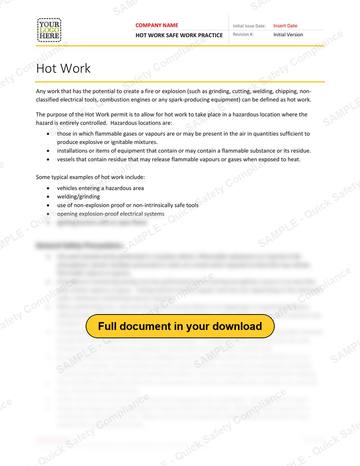
Hot Work Safe Work Practice
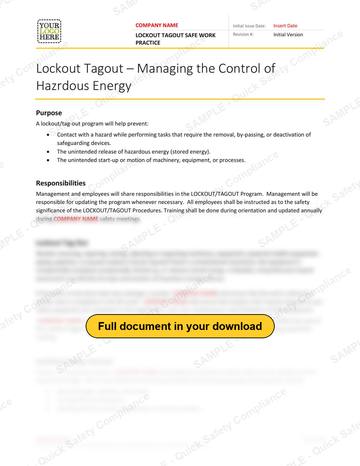
Lockout Tagout Safe Work Practice
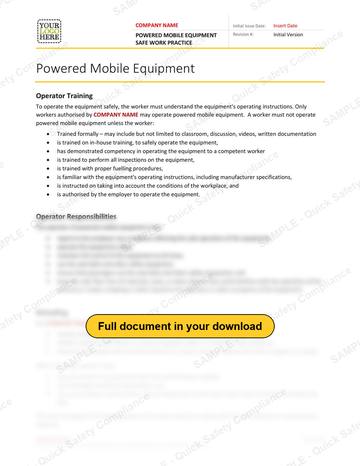
Powered Mobile Equipment Safe Work Practice
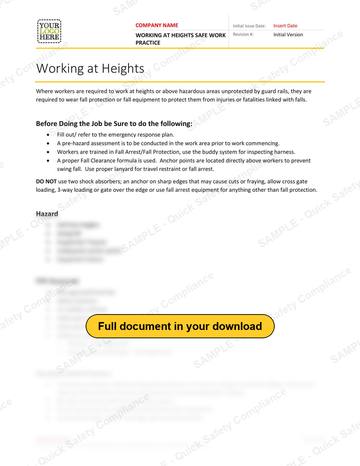
Working at Heights Safe Work Practice
Read the legislation
Official sources
- BC OHS Regulation, Part 3: rights and responsibilities (programs, inspections, first aid, new workers)
- The Occupational Health and Safety Regulations, 2020 (Saskatchewan Publications Centre)
- Manitoba Workplace Safety and Health Regulation, M.R. 217/2006
- Alberta Occupational Health and Safety Code (King's Printer)
Questions
Do clients care which name I use?
Rarely. They check that you have written instructions for the work you do and that your workers follow them. Use the name your client uses in its requirements, and be consistent inside your own program.
Can one document be both a practice and a procedure?
Yes. Many safe work practices end with step-by-step procedures for the most common tasks. Keep the steps short and in order.
How often should I review them?
At least once a year with your program review, and whenever equipment, the work or the law changes, or an incident shows a gap.
Get the document today
See every section before you pay, download it in minutes and make it yours with your company name and logo.